In Part 11 of AcuMed Clinic's 13-part Halloween TCM series, Dr. Kitt examines E Zhu — the powerful 'Devil's Turmeric' that dissolves hard accumulations — and Belladonna, history's most beautiful and most lethal plant. Two extreme herbs. Two ancient traditions. One enduring lesson about the line between medicine and poison.
*By Dr. Katrina Chojnicki-Hill, DAOM, AP, Dipl. OM — Acupuncture Physician, AcuMed Clinic, Sarasota, FL*
Ten entries into the Witch's Brew and we have moved through scorpions, leeches, flying squirrels, mandrake, and wormwood. Part 11 reaches further still — into two plants that once marked the outer boundary of what healers dared to use. E Zhu, the "Devil's Turmeric" of classical Chinese medicine, is still in current TCM practice. Atropa belladonna, the Deadly Nightshade of European folklore and Renaissance courts, belongs firmly to the pharmacy and to history. Together, they offer a reminder that the most powerful tools in any tradition are also the most demanding of precision.
---
E Zhu (莪术): Devil's Turmeric for Blood Stasis, Hard Accumulations, and Deep Tissue Pain
What Makes Zedoary Different From Kitchen Turmeric
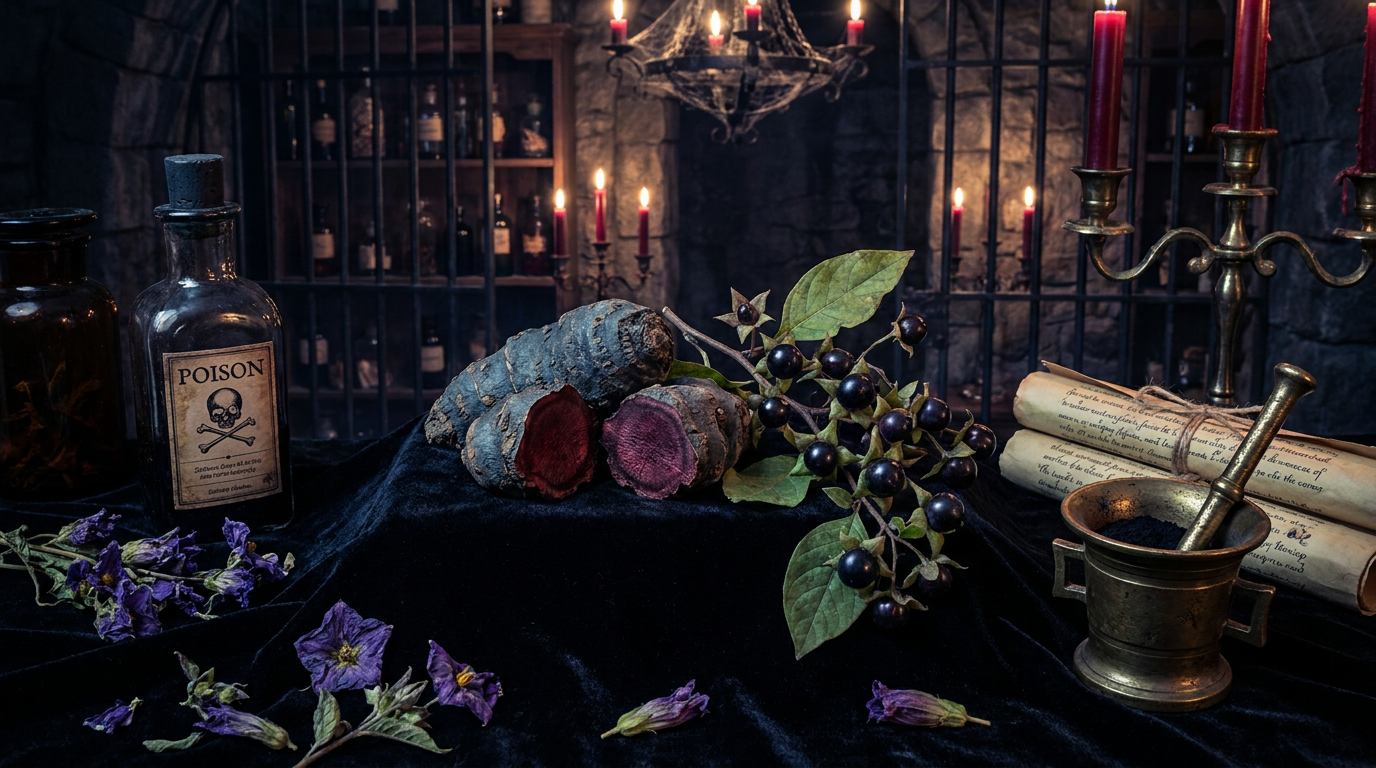
E Zhu, the dried rhizome of *Curcuma zedoaria*, belongs to the same plant family as culinary turmeric and ginger — and that is where the resemblance ends. Slice open the root and you find a grayish-blue or gray-green interior, nothing like turmeric's familiar orange. The aroma is camphoraceous and sharp. This is not a food ingredient and not a mild wellness herb. In TCM classification, E Zhu occupies one of the most powerful tiers of blood-moving herbs in the entire materia medica.
Qi Stagnation, Hard Accumulations, and What Happens When Stagnation Solidifies
In TCM theory, most pain involves some degree of stagnation — but E Zhu is not reached for mild cases. It enters the clinical picture when stagnation has persisted long enough to solidify into what classical texts call "hard accumulations": severe abdominal distension, fixed chronic low back pain that resists gentler strategies, stubborn food stagnation, and tissue masses. The volatile essential oils in E Zhu's rhizome break apart stagnant Qi, dissolve blood stasis, and penetrate accumulations that lighter herbs cannot reach.
For patients managing disc issues, sciatica, fibromyalgia, or frozen shoulder where deep tissue stagnation has a hard, fixed quality, E Zhu may appear in a carefully designed formula — though the appropriateness depends entirely on a full pattern assessment.
The Classic Dui Yao: E Zhu and San Ling
E Zhu pairs classically with San Ling (Bur-reed tuber, *Sparganium stoloniferum*) in a "Dui Yao" — a synergistic herb pair. E Zhu breaks Qi stagnation; San Ling breaks Blood stasis. Together they address both dimensions of hard accumulation simultaneously. This pairing represents one of Chinese medicine's most elegant examples of compound prescribing logic — the two herbs are not additive, they are synergistic.
E Zhu is frequently prepared as Cu E Zhu — vinegar-processed — to enhance its pain-relieving action and moderate its harsh nature. Vinegar processing is a traditional technique that directs an herb's energy inward and softens aggressive characteristics without sacrificing potency.
Modern Research on Curcuma Zedoaria — An Active Area of Study
Early-stage laboratory research has identified anti-inflammatory, antimicrobial, and anti-tumor properties in Curcuma zedoaria essential oil fractions. This remains an active area of scientific study, and more research is necessary.
E Zhu Contraindications — Hard Stops
E Zhu is strictly forbidden during pregnancy without exception. It is also contraindicated in active bleeding disorders and should not be used by patients with heavy menstrual bleeding.
---
Belladonna (Atropa belladonna): Deadly Nightshade — Historical and Educational Content Only
Warning: Belladonna is an extremely toxic plant. Do not use belladonna outside of a clinically controlled setting or a homeopathic remedy. It is very poisonous in its raw plant form. The following is historical and educational text only.
"Beautiful Lady" and the Renaissance Eye Drop
The name *belladonna* is Italian for "beautiful lady," and the story behind it reads like a cautionary tale dressed in silk. Courtiers and noblewomen across 15th- and 16th-century Europe discovered that distilled nightshade juice, applied as eye drops, caused dramatic dilation of the pupils. Wide, dark pupils were considered a sign of warmth and attraction. The practice spread through royal courts. What those women did not fully understand was that repeated use was progressively destroying their vision. The tropane alkaloids in belladonna block the parasympathetic signal that constricts the pupil — the "beautiful" effect was real, and so was the slow march toward blindness.
The Flying Ointment and the Witch Trials
Belladonna appears as a primary ingredient in the "flying ointments" described in witch trial records and herbalist texts from the 14th through 17th centuries — preparations rubbed onto the skin that produced vivid hallucinations, rapid heartbeat, and sensations of flight. The tropane alkaloids absorb transdermally. Anyone who applied such a preparation would have experienced genuine neurological effects: dissociation, spatial distortion, and the dreamlike state that fed centuries of witch mythology. The "flying" was pharmacologically real to the person experiencing it.
Toxicity: The Numbers That Matter
Two to five berries from the raw plant can be fatal to a child. The shiny, dark berries of Atropa belladonna are deceptively inviting — they look, at a glance, like edible fruit. The toxicity described here applies to the raw plant in any unprocessed form. Professionally manufactured homeopathic medicines — a complete medical system in their own right — may contain belladonna as an ingredient at pharmaceutical dilutions and are an entirely different matter.
From Nightshade to the Emergency Room
Atropine, isolated from belladonna, is on the World Health Organization's List of Essential Medicines. Emergency physicians use it to treat dangerous bradycardia and as the antidote for organophosphate poisoning, including nerve agent exposure. Scopolamine is the active ingredient in the motion sickness patch. These are strictly controlled pharmaceuticals administered at precisely calibrated doses by trained professionals. The raw plant is not safe to handle or prepare outside a controlled setting.
---
Frequently Asked Questions
Can I buy belladonna?
Yes — belladonna is available in professionally manufactured homeopathic formulations. Products like Traumeel contain belladonna as an ingredient and are available in oral tablets and drops, topical cream and gel, and sterile injectable solution used for trigger point injections. These are pharmaceutical-grade homeopathic medicines, not raw plant preparations. The danger described in this post applies specifically to the raw plant — raw berries, leaves, roots, and unprocessed plant material — which is a completely different matter.
How is E Zhu different from the turmeric I cook with?
E Zhu and culinary turmeric belong to the same plant family, but the comparison stops there. Culinary turmeric has a mild warm flavor used for color and general anti-inflammatory benefit in food. E Zhu has a grayish-blue interior, a sharp camphoraceous aroma, and a completely different phytochemical profile — classified in the strongest tier of blood-moving herbs in TCM. It is prepared under the supervision of a licensed TCM herbalist, often vinegar-processed, and used in specific doses within formulated prescriptions. It is not a food ingredient and should not be treated as a dietary supplement.
What is the E Zhu and San Ling pairing used for in TCM?
E Zhu and San Ling form a classical "Dui Yao" — E Zhu targets the Qi layer, breaking stagnant Qi; San Ling targets the Blood layer, dissolving blood stasis. Together they provide comprehensive coverage for hard accumulations that neither herb achieves alone. This pairing appears in classical formulas for severe abdominal masses, fixed pain with stagnation, and deep tissue holding presentations.
Who should not take E Zhu?
E Zhu is strictly contraindicated during pregnancy — without exception. It is also contraindicated in active bleeding disorders and should not be used by patients with heavy menstrual bleeding. These are hard stops observed by all qualified TCM practitioners.
Does the laboratory research on Curcuma zedoaria mean E Zhu treats cancer?
Early-stage laboratory research has identified anti-tumor properties in some chemical fractions of Curcuma zedoaria essential oil, and this remains an active area of scientific study, with more research necessary.
---
Traditional Chinese Herbal Medicine at AcuMed Clinic in Sarasota
The Witch's Brew series began as a Halloween project and became thirteen weeks of genuine clinical education. Every herb we cover — from dragon bone to scorpion to E Zhu — reflects something real about how Chinese medicine understands the body, pain, and the relationship between stagnation and disease.
At AcuMed Clinic on South Tamiami Trail in Sarasota, herbal medicine is part of a broader integrative approach that includes acupuncture, manual therapy, and physical medicine. Herbal prescriptions are individualized — what works for one patient's blood stasis pattern is not necessarily appropriate for another's. Patients curious about whether herbal medicine belongs in their care plan are welcome to discuss it at their initial appointment. We accept VA CCN, commercial insurance, and BCBS.
---
Halloween in Sarasota 2026: The Final Five Events of the Season
[Haunted Sarasota Trolley Tour](https://www.discoversarasotatours.com) (Nightly in October): 75-minute nighttime tour from a rolling seat — a genuine option for patients managing knee osteoarthritis who want to enjoy the season without miles of pavement.
[Boo! @ The Bazaar on Apricot & Lime](https://www.bazaaronapricotandlime.com) (October 31, 10 AM, costume contest 2 PM): If plantar fasciitis has been keeping you in sneakers, this is the kind of event worth working toward.
[University Town Center (UTC)](https://utcsarasota.com): Flexible pacing and plenty of seating throughout — a reasonable choice if you're managing sciatica and need to take breaks between stops.
[Oceanic Evening at Mote Marine](https://mote.org) (October 31, 6:15 PM, black-tie gala): An elegant evening for those whose migraines have been limiting social occasions — worth the advance planning.
[22N Halloween Bash](https://encoresrq.com) (October 31, 7 PM, $10 cover): Live music and crowd energy at Encore SRQ. If you're managing TMJ disorder or tinnitus, earplugs are not a compromise — they are the strategy that lets you stay.
However you celebrate, we hope your Sarasota Halloween is pain-free. And when the season takes a toll — AcuMed Clinic is here.
---
The Witch's Brew Series — All 13 Parts
- Part 1: Dragon Bone and Earth Dragon
- Part 2: Dragon's Blood and Cicada Skin
- Part 3: Eye of Newt and Earth Dragon — Channel Unblocker
- Part 4: Dragon Bone and Rat Guts — Sleep and Anxiety
- Part 5: Dragon's Clothes, Snake Skin, and Elderberry
- Part 6: Scorpion and Centipede — The Deadly Venom Duo
- Part 7: Water Leech and Flying Squirrel — Gothic Blood Dissolvers
- Part 8: Hornet's Nest and Mantis Pod — Tooth Pain and Bladder
- Part 9: Ground Beetle and Mandrake — The Bone Setter's Trauma Kit
- Part 10: Horsefly and Wormwood — Blood Stasis and Digestive Health
- Part 11: Devil's Turmeric and Belladonna — Blood Stasis and Hard Accumulations
- Part 12: Devil's Arrow and the Black Snake — Blood Stasis, Eczema, and Joint Stiffness
- Series Finale: The 13 Ghost Points — Anxiety, PTSD, and Emotional Pain
---
*Disclaimer: This post is provided for educational purposes only and does not constitute medical advice, diagnosis, or treatment. Regarding belladonna specifically: Atropa belladonna (Deadly Nightshade) is an extremely toxic plant. Two to five berries can be fatal to a child. If you or someone in your household has consumed any part of the belladonna plant, contact Poison Control immediately at 1-800-222-1222. The pharmaceutical compounds derived from belladonna are strictly controlled medications prescribed and administered only by licensed medical professionals. Regarding E Zhu: E Zhu is strictly forbidden during pregnancy and should not be used by patients with active bleeding disorders or heavy menstrual bleeding without supervision by a qualified TCM practitioner.*