The Witch's Brew series closes with its most haunting chapter: the 13 Ghost Points, a classical acupuncture protocol from 7th-century China now used to support PTSD, panic disorder, and severe anxiety. Dr. Kitt explores the history, the neurobiology, and what it means for patients in Sarasota today.
*By Dr. Katrina Chojnicki-Hill, DAOM, AP, Dipl. OM — Acupuncture Physician, AcuMed Clinic, Sarasota, FL*
Every good story deserves a final chapter — and what better way to close a Halloween series on the strange ingredients of Traditional Chinese Medicine than with a protocol designed, quite literally, to drive out demons?
The Witch's Brew began thirteen weeks ago with Dragon Bone and Earth Dragon, wound through scorpion venom, water leeches, and belladonna, and arrives here at its most haunting destination: the 13 Ghost Points. This is Part 13 — the series finale — and it belongs entirely to acupuncture. No herbs. Just needles, ancient anatomy, and a 7th-century physician who understood mental anguish in ways that still hold up.
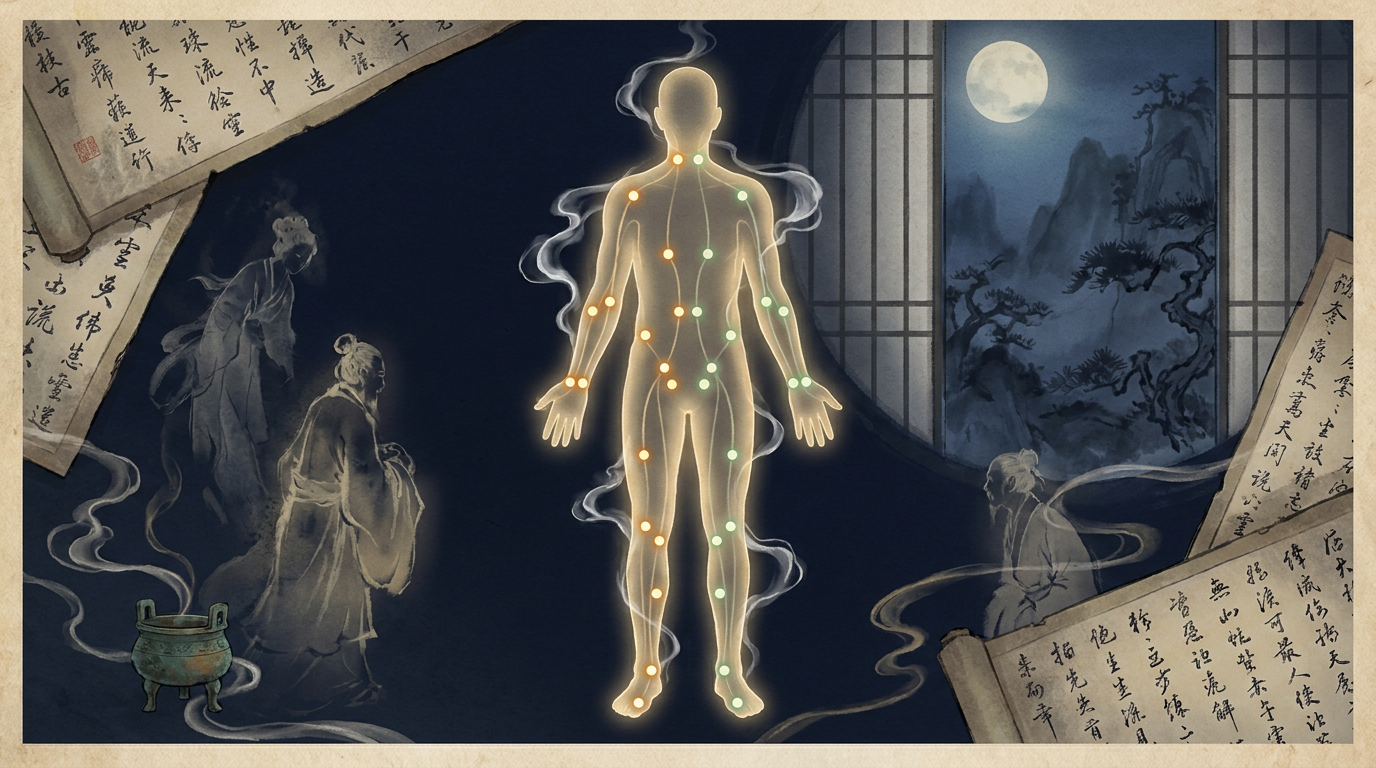
These thirteen classical acupuncture points were codified by Sun Simiao (孫思邈), Tang Dynasty physician and author of the *Essential Prescriptions Worth a Thousand Gold*, for the treatment of what he called ghost possession (鬼邪, *Gui Xie*). His intention: to chase out whatever had taken over a patient's mind and restore the person underneath.
---
What Did "Ghost Possession" Mean in Ancient Chinese Medicine?
In Sun Simiao's era, *Gui* (鬼, "ghost") was not a supernatural claim — it was a clinical description. Shorthand for a mind overtaken by something invisible: unprocessed trauma, acute emotional shock, fever-induced psychosis, sudden mania, or the profound grief that hollows a person out until they no longer recognize themselves.
When the Shen (神, Spirit or Mind) became weak or overwhelmed — from illness, loss, extreme stress, or sustained suffering — patients might exhibit personality changes, paranoid speech, uncontrollable weeping, compulsive behavior, or a dissociated flatness. In the language of the time, a ghost had moved in and the self had moved out.
The Ghost Point protocol was designed to shore up the Shen, open the channels of the Heart and Pericardium, and show that ghost the door.
---
The 13 Ghost Points: Key Points and Their Clinical Roles
Sun Simiao numbered his points carefully. Modern practitioners do not typically needle all thirteen at once; rather, they select three to five based on the patient's presentation and work in stages according to the severity and character of the condition.
Ghost Palace — GV 26 (Renzhong): The Emergency Revival Point
Located at the midline of the philtrum — the groove between nose and upper lip — Ghost Palace is the emergency revival point of the protocol. It has been used for centuries to restore consciousness during fainting, severe shock, and acute panic. Its position along the Du (Governing) vessel connects it to the spine and brain; stimulation here sends an immediate awakening signal to the central nervous system. Modern practitioners reach for this point in acute crisis presentations.
Ghost Cave — EX-HN 3 (Yintang): Calming Anxiety, Insomnia, and the Racing Mind
Yintang sits directly between the eyebrows — the location most people associate with the "third eye." It is arguably the most widely used anxiety and insomnia point in clinical acupuncture today. Research suggests needling Yintang may downregulate activity in the amygdala, the brain's threat-detection center, which is chronically hyperactivated in anxiety disorders and fibromyalgia. Patients frequently report a profound settling of the mind within minutes, and many fall asleep on the table before the session ends.
Ghost Nest — PC 5 (Jianshi): Clearing the Fog of Panic and Emotional Overwhelm
The Pericardium channel was understood as the Protector of the Heart — shielding the Shen from what could not yet be processed. PC 5, on the inner forearm, clears what classical texts called *Phlegm misting the Mind* — the chest-tightening dissociation of panic disorder, the blunted affect of deep depression. Contemporary practitioners use it in complex trauma presentations and conditions where a patient reports feeling emotionally stuck or cut off from themselves.
Ghost Bed — ST 6 (Jiache): Releasing the Jaw and Suppressed Emotion
Located at the masseter muscle of the jaw, Ghost Bed addresses the tight-jawed, teeth-clenching physical pattern of long-held emotional suppression. It relaxes the jaw, may help reduce TMJ disorder symptoms that worsen under stress, and helps patients begin to express what has been locked in. The jaw point pairs well with CV 24 (below the lower lip) to open both the physical and expressive channel together.
Ghost Road — BL 62 (Shenmai): Anchoring the Anxious Nervous System
Shenmai anchors scattered Yang energy — reducing the restless, hypervigilant agitation of anxiety and calming the nervous system's baseline state of alarm. It is frequently used for insomnia driven by an overactive mind and for the physical exhaustion that follows sustained anxiety or PTSD-related hyperarousal. Patients with tension headaches driven by nervous system overactivation often find this point particularly effective.
Ghost Hall — GV 23 (Shangxing): Quieting Intrusive Thoughts
Situated on the top of the head toward the frontal scalp, Ghost Hall was used for intrusive thoughts — the kind that arrive unbidden and loop without resolution. Combined with Yintang, it addresses the cognitive dimension of anxiety: the inability to stop thinking about what the mind most wants to release. Patients with migraines triggered by stress and rumination may recognize this pattern.
---
From Exorcism to Neurobiology: What Modern Research Suggests
Modern neuroscience offers a compelling reframe for what Sun Simiao observed clinically 1,400 years ago.
Vagus nerve stimulation. Several Ghost Points sit near branches of the trigeminal and median nerves. Studies indicate that stimulating these pathways can trigger a parasympathetic cascade — shifting the nervous system from fight-or-flight toward rest-and-digest. For patients managing panic attacks, chronic anxiety, or PTSD-related hyperarousal alongside neck pain or chronic low back pain, this regulatory shift addresses both layers simultaneously.
Endorphin and serotonin release. Needling neurologically dense areas has been associated in research with the release of beta-endorphins and serotonin — neurochemical responses that may account for the deep relaxation patients report during acupuncture and the mood stabilization that develops over a course of care.
Amygdala downregulation. Neuroimaging research suggests acupuncture at points including Yintang is associated with reduced activation in the amygdala and related limbic structures. For PTSD and panic disorder — where the amygdala functions like a smoke alarm with a broken sensor — this effect may help explain reported improvements in reactivity and the ability to feel safe.
Sun Simiao did not have fMRI. But the clinical phenomena he was describing — the hijacked mind, the dissociated self, the hypervigilant body that cannot rest — are phenomena any modern clinician would recognize.
---
Frequently Asked Questions
Are the 13 Ghost Points still used in clinical acupuncture today?
Yes. The Ghost Points remain in active clinical use, with modern practitioners using modified selections for anxiety disorders, PTSD, panic disorder, and addiction recovery support. The protocol has been refined over 1,400 years and continues to appear in advanced acupuncture training and integrative medicine practice.
Do practitioners needle all 13 Ghost Points in one session?
No. Practitioners typically select three to five points per session based on the patient's presenting condition, working in stages over a course of care. Using all thirteen at once would be unusual; selection is adapted as the patient responds to treatment.
Does needling the Ghost Points hurt?
Acupuncture needles are hair-thin — much finer than needles used for injections. The typical sensation is mild pressure or a brief dull ache called *De Qi*, which signals effective stimulation. Ghost Point sessions are often deeply relaxing, and it is not uncommon for a patient to fall asleep on the table during treatment.
Is the Ghost Point protocol appropriate for PTSD and mental health conditions?
Acupuncture — including Ghost Point protocols — may help support nervous system regulation, sleep quality, and anxiety management as part of a broader care plan. It is not a standalone treatment for serious mental health diagnoses and does not replace psychotherapy, medication, or care from a licensed mental health professional. At AcuMed Clinic in Sarasota, Dr. Kitt is a VA CCN provider who specializes in PTSD and works with patients to address both the physical and neurological dimensions of chronic stress and trauma.
Is "ghost possession" a supernatural claim?
No. In classical Chinese medicine, the term referred to clinical presentations — personality changes, dissociation, mania, and uncontrollable emotional states — rather than a literal supernatural entity. Sun Simiao was describing observable phenomena in the language of his era. Modern practitioners understand these presentations through neurology and psychology; the underlying clinical observations about the mind under extreme stress remain accurate and clinically relevant.
---
Acupuncture for Anxiety, PTSD, and Mental Health at AcuMed Clinic in Sarasota
At AcuMed Clinic in Sarasota, Dr. Kitt brings a focused clinical lens to the overlap between chronic pain and mental health — an intersection that is far more common than either specialty tends to acknowledge. Conditions like fibromyalgia, neuropathy of the feet, migraines, and tension headaches are frequently accompanied by anxiety, disrupted sleep, and emotional dysregulation. Treating one without addressing the other often means incomplete relief.
Dr. Kitt is an active VA Community Care Network (CCN) provider, meaning veterans in the greater Sarasota area can access acupuncture care through their VA benefits with a Community Care referral. PTSD is a condition she specializes in — and for many veterans, chronic physical pain and PTSD create a reinforcing cycle that conventional pain management addresses only partially.
For patients managing sciatica, neck pain, chronic low back pain, or knee osteoarthritis alongside anxiety or sleep disruption, acupuncture offers an approach that addresses both dimensions within the same treatment.
---
After the Cauldron Goes Cold — Sarasota Seasonal Wellness
Halloween season in Sarasota is genuinely something — warm Gulf air, art district energy, and October evenings that make the rest of the country jealous. But the cauldron has cooled now, and Sarasota moves into the holiday season with its own rhythm: farmers markets filling back up on weekends, the snowbirds arriving, the bay light going golden in the late afternoons.
It is also the time of year when many patients start reflecting on what has lingered. The back pain that has been "manageable" for three years. The knee or hip that limits the morning walk. The anxiety that has been running quietly in the background long before the holidays gave it a reason. If this series sparked a question — about TCM, about acupuncture, about whether any of this might be relevant for you — the winter season is a good time to ask it out loud.
---
The Complete Witch's Brew Series — All 13 Parts
- Part 1: Dragon Bone and Earth Dragon — The Ancient Sedatives
- Part 2: Dragon's Blood and Cicada Skin
- Part 3: Eye of Newt and Earth Dragon — Channel Unblocker
- Part 4: Dragon Bone, Rat Guts, and Sleep Anxiety
- Part 5: Dragon Clothes, Snake Skin, and Elderberry
- Part 6: Scorpion and Centipede — The Deadly Venom Duo
- Part 7: Water Leech and Flying Squirrel — Gothic Blood Dissolvers
- Part 8: Hornet's Nest and Mantis Pod — Tooth Pain and Bladder
- Part 9: Ground Beetle and Mandrake — The Bone Setter's Trauma Kit
- Part 10: Horsefly and Wormwood — Blood Stasis and Digestive Health
- Part 11: Devil's Turmeric and Belladonna
- Part 12: Devil's Arrow and Black Snake — Blood Stasis and Skin
- Part 13 (Series Finale): The 13 Ghost Points *(you are here)*
Thirteen weeks. Thirteen parts. The cauldron is cold. The real work begins now.
---
*If you or someone you know is experiencing a mental health crisis, please seek support from a licensed mental health professional or call or text 988 (Suicide and Crisis Lifeline), available 24 hours a day, seven days a week. Acupuncture is a supportive care modality and is not a substitute for crisis intervention services.*
*This content is provided for educational purposes only and does not constitute medical advice, diagnosis, or treatment. Always consult a licensed healthcare provider before beginning any treatment protocol.*