In Part 9 of AcuMed Clinic's Halloween TCM series, Dr. Kitt explores Tu Bie Chong (ground beetle), TCM's legendary bone-knitting herb, alongside Mandrake Root — history's most famous surgical anesthetic. Discover why ancient healers may have paired them for fracture recovery and trauma care.
*By Dr. Katrina Chojnicki-Hill, DAOM, AP, Dipl. OM — Acupuncture Physician, AcuMed Clinic, Sarasota, FL*
Every October, the apothecary jars come off the shelf. Roots said to scream when pulled from the earth. Beetles ground into powder. The original witch's brew was not fantasy — it was the pharmacopeia of the ancient world, sourced from the strange and the fearless, compounded by healers who had no choice but to use what nature offered.
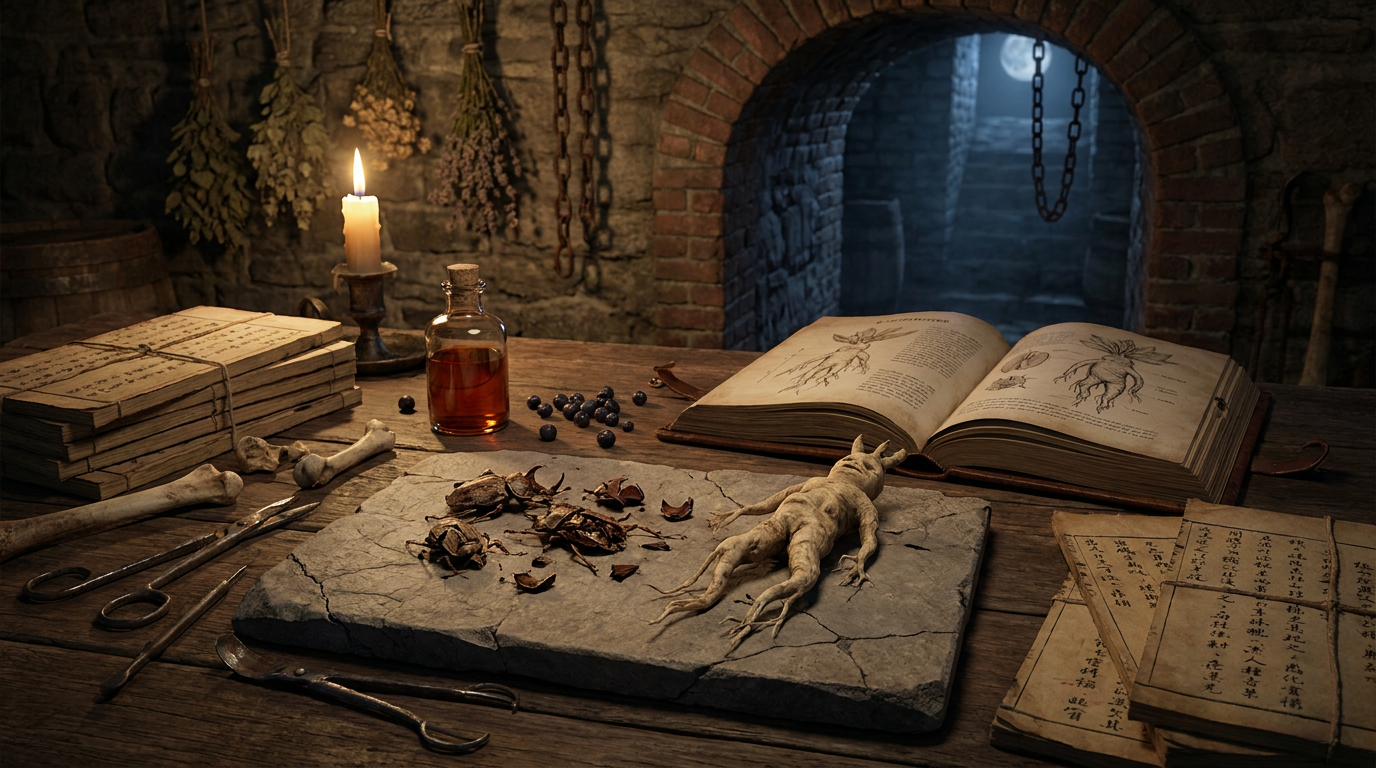
Welcome to Part 9 of AcuMed Clinic's Halloween TCM series. This installment features two herbs that ancient surgeons and martial arts practitioners alike considered essential for severe trauma care: Tu Bie Chong (土别虫), the wingless ground beetle used by licensed TCM practitioners for fracture recovery and blood stasis, and Mandrake Root (Mandragora officinarum), the nightshade-family plant whose alkaloids served as the original surgical anesthetic. One of these is a current TCM herb used in licensed clinical practice today. The other belongs entirely to history — and this distinction matters enormously.
The Witch's Brew Series: - Part 1: Long Gu + Di Long — Anxiety, Insomnia, Joint Pain, Sciatica - Part 2: Xue Jie + Chan Tui — Bruising, Blood Stasis, Sore Throat - Part 3: Bai Jie Zi + Di Long — Joint Pain, Muscle Spasms - Part 4: Long Gu + Valerian Root — Anxiety, Insomnia - Part 5: Long Yi + Elderberry — Skin, Immunity - Part 6: Quan Xie + Wu Gong — Nerve Pain, Migraines - Part 7: Shui Zhi + Wu Ling Zhi — Blood Stasis - Part 8: Lu Feng Fang + Sang Piao Xiao — Tooth Pain, Bladder
---
Tu Bie Chong (土别虫): The Bonesetting Bug for Fracture Recovery and Trauma
Tu Bie Chong — also called Di Bie Chong — is the dried body of the wingless female *Eupolyphaga* or *Steleophaga* beetle, two species that look more like flat cockroaches than the beetles most people picture. Ground, processed, and incorporated into formulas, this insect medicine has been central to TCM's approach to severe trauma for centuries.
The TCM Framework: Blood Stasis and Bone Healing
In TCM, severe trauma — a broken bone, a torn tendon, a significant sprain — causes massive Blood Stasis at the injury site. Pooled, stagnant blood blocks the delivery of nutrients needed for tissue repair. Without clearing that stasis, the body cannot complete the knitting process, regardless of how well the fracture is set.
Tu Bie Chong has traditionally been used to address both sides of this problem simultaneously: breaking up stagnant blood stasis at the injury site and promoting active healing of bone and tendon. This dual action makes it a core ingredient in the classic martial arts trauma formulas known as *Die Da* ("fall and hit") remedies — used for broken bones, torn tendons, and severe sprains.
For Sarasota patients managing post-knee-replacement pain, post-hip-replacement pain, rotator cuff pain, or chronic low back pain following injury, the underlying TCM concept maps onto questions that modern patients ask every day: why do some injuries heal cleanly while others stay stiff, poorly vascularized, and chronically aching?
Modern research on *Eupolyphaga* extracts has identified active proteins, amino acids, and fibrinolytic enzymes that may help explain its traditional uses. The presence of fibrinolytic activity in an herb classically used for blood stasis and bone healing is not coincidental — it is an active area of scientific study.
Tu Bie Chong Preparation and Contraindications
Preparation: Tu Bie Chong is traditionally cleaned and stir-baked with yellow wine or salt, then ground into powder and formulated into pills, capsules, or topical poultices. Its salty, earthy, and somewhat pungent flavor means most patients receive it in coated pills or capsules.
Critical contraindications:** - **Strictly forbidden during pregnancy** — without exception - **Not for use with active bleeding disorders** - **Not for use with prescription blood thinners without licensed medical supervision
Tu Bie Chong is not available over the counter in meaningful therapeutic form. Its use belongs with a trained practitioner who can assess your complete health picture.
---
Mandrake Root: The Screaming Root — Historical and Educational Content Only
Important notice: Raw mandrake root is extremely toxic. The danger described here applies to raw plant material. Professionally manufactured homeopathic preparations containing mandrake are a separate matter. What follows covers the raw plant and its historical use only.
The Screaming Root in Folklore
*Mandragora officinarum* is a Mediterranean plant in the nightshade family (Solanaceae). Its thick, often bifurcated taproot resembles the rough outline of a human figure — a resemblance that made it one of the most mythologized plants in recorded history.
Medieval and ancient folklore held that the mandrake root emitted a piercing, fatal shriek when pulled from the earth. Ritualists reportedly tied a hungry dog to the plant, stepped well back, blew a horn to startle the animal, and let the dog bear the consequence. Whether this reflected sincere belief or practical caution around an acutely dangerous plant is open to interpretation — given what the plant actually contains, the practical caution was well-founded.
Why Ancient Surgeons Used Mandrake Root
Ancient Greek and Roman surgeons used wine infused with mandrake root to render patients unconscious before surgery and amputation — the original anesthetic, centuries before ether or chloroform.
Mandrake root contains potent anticholinergic alkaloids: scopolamine, hyoscyamine, and atropine. These shut down pain signal transmission, induce deep sedation, cause muscle relaxation, and at higher doses produce intense hallucinations. In surgical terms: the patient stopped feeling the procedure.
Why Raw Mandrake Belongs Entirely in the Past
The same chemistry that made mandrake useful to ancient surgeons makes it acutely dangerous outside a controlled clinical setting. Raw mandrake produces severe anticholinergic toxidrome: blurred vision, cardiac arrhythmias, extreme delirium, respiratory depression, and potentially fatal outcomes. There is no safe exploratory dose at home.
The active alkaloids have been isolated, purified, and are now used as strictly controlled pharmaceuticals: scopolamine patches for motion sickness, atropine in emergency cardiac care, hyoscyamine for specific gastrointestinal conditions — dispensed by physicians and pharmacists only. Mandrake root as an herb has no role in modern clinical practice.
---
Ancient Trauma Care: What Mandrake and Tu Bie Chong Tell Us
In their historical pairing, the two herbs addressed different phases of severe trauma. Mandrake served as the anesthetic: it numbed pain, relaxed spasms, and sedated the patient while the surgeon worked. Tu Bie Chong served as the builder: it cleared pooled blood at the fracture site and promoted healing during recovery.
One quieted the patient. The other began the repair. The underlying insight — that stagnation impairs healing, and that circulation to the injury site matters as much as structural repair — is one that integrative practitioners work with today, using tools that are safe, evidence-informed, and appropriate for each individual patient.
---
Frequently Asked Questions
Is mandrake root safe to use at home or as a supplement?
Raw mandrake root is extremely toxic — the plant contains potent anticholinergic alkaloids (scopolamine, hyoscyamine, and atropine) that can cause heart arrhythmias, respiratory depression, severe delirium, and potentially fatal outcomes. This applies to raw plant material. Professionally manufactured homeopathic preparations containing mandrake are a separate matter and are not what this warning addresses.
What is Tu Bie Chong traditionally used for in TCM?
Tu Bie Chong has traditionally been used for severe trauma recovery — fractures, torn tendons, and significant sprains — where Blood Stasis at the injury site is thought to impede healing. It is a core ingredient in classic *Die Da* (martial arts trauma) formulas. Modern research has identified fibrinolytic enzymes in *Eupolyphaga* extracts that may help explain its traditional role, though this remains an active area of study.
Who should not use Tu Bie Chong?
Tu Bie Chong is strictly contraindicated during pregnancy. It should not be used by anyone with an active bleeding disorder, and it must not be combined with prescription blood thinners without close licensed medical supervision. Always disclose all medications and health conditions to your TCM practitioner before beginning any herbal formula.
How was mandrake root used in ancient surgery?
Ancient Greek and Roman surgeons used wine infused with mandrake root as a pre-surgical sedative — the original anesthetic. The anticholinergic alkaloids induced sedation, pain suppression, and muscle relaxation, allowing surgeons to perform amputations and other procedures. This is one of the earliest documented plant-based anesthetic uses in Western medical history.
Can TCM herbs support bone healing and fracture recovery?
TCM has a long tradition of addressing fracture recovery through herbs believed to clear Blood Stasis and support tissue regeneration, with Tu Bie Chong among the most historically significant. Licensed TCM practitioners may incorporate herbal medicine as part of a comprehensive approach alongside acupuncture and manual therapy. These work alongside — not in place of — conventional fracture management and orthopedic care.
---
Traditional Chinese Herbal Medicine at AcuMed Clinic in Sarasota
At AcuMed Clinic in Sarasota, Dr. Kitt works with patients navigating pain, trauma recovery, mobility challenges, and chronic conditions using drug-free, integrative approaches. Herbs like Tu Bie Chong are part of a licensed practitioner's toolkit — considered thoughtfully, with full attention to contraindications, current medications, and your individual health picture.
Conditions we commonly work with include disc issues, sciatica, knee osteoarthritis, hip osteoarthritis, frozen shoulder, achilles tendinitis, runners knee, and more. If you are recovering from injury or managing chronic joint pain, we welcome the conversation.
---
Halloween in Sarasota 2026: Five Events Worth Moving For
[Haunted Sarasota Trolley Tour](https://www.discoversarasotatours.com) (Nightly in October): Seated, narrated nighttime tour — one of the better ways to enjoy the season without logging miles on an inflamed heel.
[Boo! @ The Bazaar on Apricot & Lime](https://www.bazaaronapricotandlime.com) (October 31, 10 AM, costume contest 2 PM): Festive, walkable market with low-impact browsing — manageable even for those navigating frozen shoulder.
[St. Armands Circle](https://www.starmandscircleassoc.com) Halloween: Flat, walkable, with plenty of places to rest — well-suited for patients working through runners knee.
[Oceanic Evening at Mote Marine](https://mote.org) (October 31, 6:15 PM): Elegant black-tie gala with lower sensory stimulation — a solid alternative for patients whose migraines are triggered by loud environments.
[University Town Center (UTC)](https://utcsarasota.com) Halloween: Climate-controlled walking with seating throughout — a practical choice for those managing knee osteoarthritis who need to pace themselves.
However you celebrate, we hope your Sarasota Halloween is pain-free. And when the season takes a toll — AcuMed Clinic is here.
---
*Part 10 of the Witch's Brew is already simmering — two more substances from the edge of the ancient apothecary. Stay tuned.*
---
*The information in this post is for educational and historical purposes only and does not constitute medical advice. Mandrake root in any raw form is acutely toxic — do not seek it out, purchase it, or use it outside a supervised pharmaceutical or clinical setting. Tu Bie Chong is strictly contraindicated during pregnancy, with active bleeding disorders, and with prescription blood thinners without licensed medical supervision. Traditional Chinese herbal medicine should be administered by a licensed practitioner. Consult a qualified healthcare provider before making changes to your treatment plan.*