In Part 3 of AcuMed Clinic's Halloween TCM series, we unmask the real herb behind Shakespeare's most famous potion ingredient — and pair it with Di Long, the Earth Dragon, for joint pain, nerve pain, muscle spasms, and cold chest congestion.
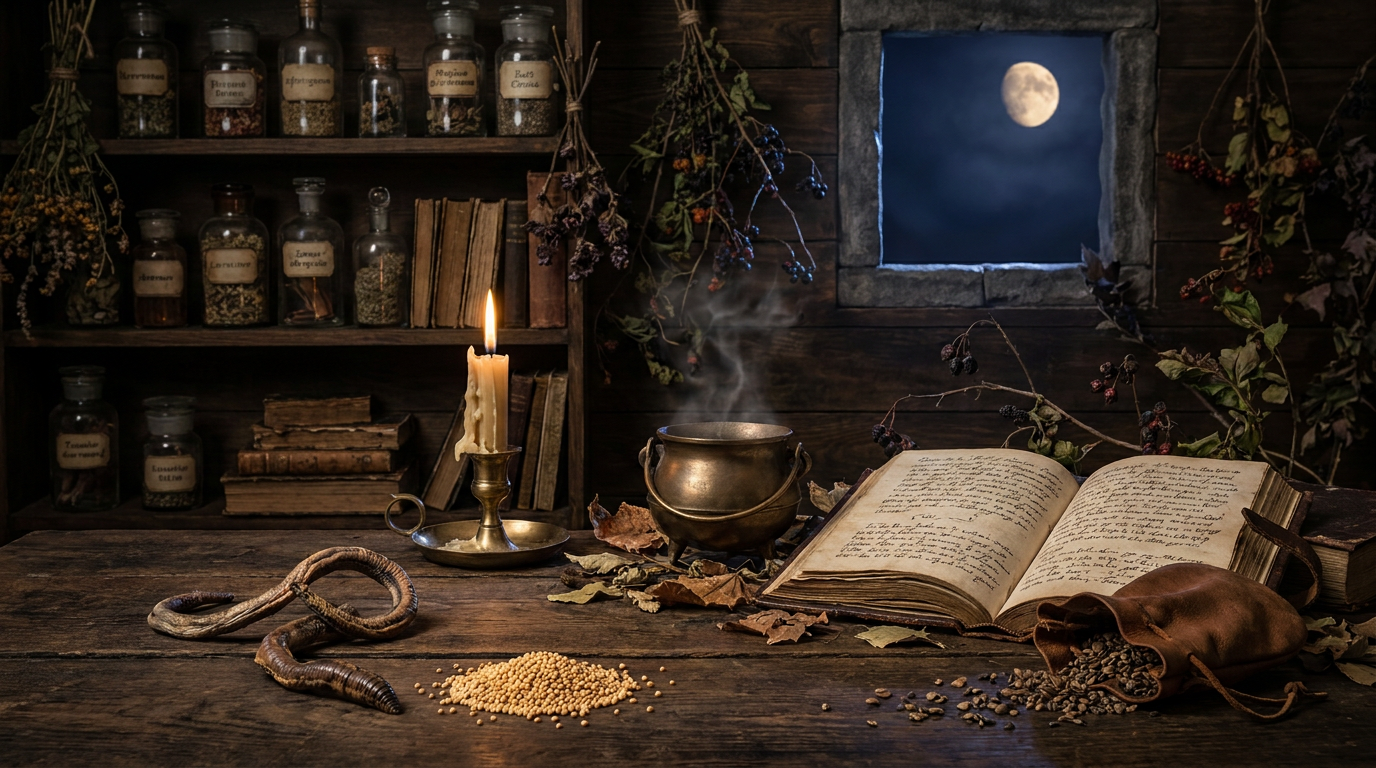
*By Dr. Katrina Chojnicki-Hill, DAOM, AP, Dipl. OM — Acupuncture Physician, AcuMed Clinic, Sarasota, FL*
Welcome back to The Witch's Brew — AcuMed Clinic's Halloween series on the Traditional Chinese Medicine herbs that sound like they were pulled straight out of a cauldron. In Part 1, we opened the cabinet with Long Gu (Dragon Bone) and Di Long (Earth Dragon), exploring how they are used to address anxiety, insomnia, sciatica, and joint pain. In Part 2, we stirred in Xue Jie (Dragon's Blood) and Long Yi (Cicada Skin) for bruising, skin conditions, and sore throat.
For Part 3, we are bringing back Di Long — but from a completely new angle — and pairing it with a herb that has one of the most famous secret identities in the history of medicine.
---
What Shakespeare's Witches Were Actually Saying
*"Eye of newt and toe of frog, wool of bat and tongue of dog..."*
Most people who know *Macbeth* assume the witches were describing a recipe for actual amphibians. They were not. Medieval herbalists used animal code names to protect proprietary formulas from rival healers and to lend dramatic authority to their potions. "Eye of Newt" was a folk nickname for something far more ordinary: the small, round, pale yellow seed of the white mustard plant (*Brassica alba*). Hold a mustard seed at arm's length and the resemblance is clear — tiny, pale, with a dark spot at the center. "Eye."
Other famous examples from the same era: "Mouse Ear" meant Hawkweed, "Bat's Wing" meant Holly Leaf, and "Adder's Tongue" meant Dogstooth Violet. Shakespeare's witches were not inventing nightmare ingredients — they were naming a real herbal cabinet, and its contents were far stranger and more useful than fiction.
---
Bai Jie Zi (白芥子): The Eye of Newt of Traditional Chinese Medicine
In TCM, white mustard seed is called Bai Jie Zi and classified as a warming, pungent herb that enters the Lung and Stomach meridians. It has been used in Chinese herbal medicine for centuries to address patterns of cold, dampness, and obstruction — the same patterns that tend to flare in autumn when damp air settles into stiff joints and lungs that will not clear.
Bai Jie Zi for Chest Congestion and Stubborn Cough
Bai Jie Zi is most associated with cold phlegm in the lungs — thick, white, sticky congestion that lingers after a cold or accumulates when damp weather drags on. In TCM theory, this phlegm forms when cold and dampness impair the Lung's ability to disperse and descend. Bai Jie Zi's warming, acrid nature has traditionally been used to help transform this cold phlegm and restore movement to the Lung system, making it a classical support for chest congestion, productive cough, and bronchial stagnation that just will not shift.
Western folk medicine arrived at a similar conclusion through experience. The old mustard plaster — ground mustard seed mixed with flour and warm water, spread on cloth, laid on the chest — was a household remedy across Europe and early America. The chemistry responsible includes glucosinolates and sinigrin, which stimulate mucous membranes, generate localized heat, and may help break up congestion. The plaster was removed before skin irritation set in, but the warming effect on the chest wall was the point: draw circulation toward the lungs, restore warmth, clear the obstruction.
Bai Jie Zi for Cold-Type Joint Pain, Muscle Aches, and Circulation
Beyond the lungs, Bai Jie Zi appears in formulas targeting cold-damp joint pain and muscle aching. When cold and dampness settle into the channels — the pathways through which Qi and Blood circulate to nourish joints, muscles, and nerves — tissues become stiff, cold, heavy, and tender. The warmth of Bai Jie Zi helps disperse this cold obstruction and restore circulation to areas where cold has caused constriction.
For many Sarasota patients, this pattern shows up as that deep, achy stiffness in the knees, hips, or lower back that arrives with cool, damp mornings — even on the Gulf Coast where cold is relative. Patients managing knee osteoarthritis, hip osteoarthritis, or persistent muscle aches that worsen in damp weather may recognize this pattern in their own experience.
---
Di Long (地龙): The Earth Dragon Returns as a Channel Unblocker
We introduced Di Long — dried earthworm (*Pheretima aspergillum*) — in Part 1 of The Witch's Brew, focusing on its role in calming the nervous system and relieving joint pain. In Part 3, we are approaching Di Long from its other major clinical angle: clearing obstructed channels.
Classical TCM holds a principle that has appeared in texts for over a thousand years: *"If there is free flow, there is no pain. If there is no free flow, there is pain."* When Blood and Qi stagnate — from injury, cold invasion, inflammation, or chronic tension — obstruction builds and pain follows. Di Long's name reflects the observation that earthworms burrow through dense, compacted earth to create open passages. Ancient herbalists mapped that nature directly onto the human body.
Di Long for Sciatica, Nerve Pain, and Muscle Spasms
Di Long is one of TCM's most valued herbs for clearing the channels and collaterals — the network of pathways through which Qi and Blood travel to nourish joints, nerves, and soft tissue. Conditions where TCM practitioners have traditionally used Di Long as a supporting herb include:
- Sciatica and chronic low back pain: Deep, radiating nerve pain traveling down the leg is often classified in TCM as channel obstruction with stagnation. Di Long is frequently paired with Blood-moving herbs to address this pattern.
- Neuropathy of the feet: Numbness, tingling, and nerve discomfort in the lower extremities may be addressed through formulas that open obstructed channels and calm Internal Wind.
- Fibromyalgia and widespread muscle aching: Diffuse pain that shifts and moves is a classic presentation of Wind-Bi in TCM, and Di Long has a long history of use in Wind-Bi formulas.
- Muscle spasms and cramping: Di Long is used to help quell Internal Wind, which manifests in involuntary muscle movement, twitching, cramping, and spasm.
- Post-surgical joint pain: Patients recovering from hip replacement or knee replacement may benefit from herbal support to restore channel circulation in the affected joint.
Modern research has identified lumbrokinase — a fibrinolytic enzyme found in earthworm tissue — that may help break down fibrin and support microcirculation. In Sarasota practices, Di Long often appears in custom formulas alongside herbs that warm the channels, move Blood, or tonify the Kidney system — depending on what the full clinical picture reveals.
---
How Di Long and Bai Jie Zi Work Together
These two herbs address obstruction at different layers.
Di Long works structurally — clearing deep channel and nerve-level stagnation, calming the Internal Wind that drives muscle spasms, and restoring circulation to congested joints and tissues.
Bai Jie Zi works through temperature — melting cold phlegm from the lungs, dispersing the cold that stiffens joints and constricts muscle tissue, and drawing warmth back into areas where cold has caused accumulation.
Together, they speak to what TCM calls Cold-Damp Bi Syndrome — the pattern where cold and dampness obstruct the channels simultaneously, producing the combination of deep joint pain, stiff achy muscles, and congested lungs that often arrives together in autumn. Whether on a coastline in the UK or on Sarasota's Gulf Coast, the body's response to cool, damp autumn air follows the same pattern.
---
Frequently Asked Questions
What is Bai Jie Zi, and how is it used in TCM?
Bai Jie Zi is the TCM name for white mustard seed (*Brassica alba*), classified as a warming, pungent herb that enters the Lung and Stomach meridians. It has traditionally been used to help transform cold phlegm in the lungs, address cold-type joint pain and muscle aching, and support circulation in areas where cold and dampness have caused obstruction. It is most commonly prescribed as part of a custom formula tailored to the individual patient's pattern, not as a standalone supplement.
Is "Eye of Newt" really just a mustard seed?
Yes — "Eye of Newt" is a medieval folk code name for the small, pale, round seeds of white mustard (*Brassica alba*). Medieval herbalists used animal nicknames to protect their formulas and maintain an air of mystery. Shakespeare's witches in *Macbeth* were drawing on a real herbalist naming tradition. Other famous examples include "Bat's Wing" for Holly Leaf and "Mouse Ear" for Hawkweed.
How is Di Long used in Part 3 differently than in Part 1?
In Part 1 of The Witch's Brew, Di Long was introduced in the context of calming the nervous system, supporting sleep, and relieving joint pain. In Part 3, we focus on its role as a channel-clearing herb — specifically its use in formulas for sciatica, nerve pain, muscle spasms, and conditions involving deep obstruction in the channels and collaterals. The same herb has multiple classical clinical applications, and pairing it with different herbs shifts the clinical emphasis.
Can Bai Jie Zi be used for joint pain, or is it only for the lungs?
Bai Jie Zi addresses both. While its best-known application is cold phlegm in the lungs, it is also used in formulas targeting cold-damp joint pain, muscle aching, and poor circulation in the limbs. Because it is warming and dispersing, it helps move obstruction caused by cold and dampness wherever it has settled — in the chest, joints, or soft tissue. The clinical context and formula composition determine which action is emphasized.
Should I take these herbs on my own?
Chinese herbal medicine is most effective and safest when prescribed by a licensed practitioner following a full clinical intake. Self-prescribing without accounting for your complete health pattern, constitution, and current medications can result in formulas that do not match your pattern or that interact adversely with other treatments. Always consult a licensed practitioner before beginning any herbal regimen.
---
Traditional Chinese Herbal Medicine at AcuMed Clinic in Sarasota
At AcuMed Clinic on South Tamiami Trail in Sarasota, Dr. Kitt incorporates Traditional Chinese herbal formulas alongside acupuncture as part of personalized treatment plans for chronic pain, joint conditions, nerve health, and seasonal respiratory patterns. A herbal consultation begins with a full intake — pulse, tongue, and a complete health picture — because no two formulas should be alike even when two patients share the same Western diagnosis.
If you are managing chronic low back pain, neck pain, frozen shoulder, plantar fasciitis, or other concerns that have not fully responded to conventional approaches, a consultation with Dr. Kitt can help you understand whether herbal medicine, acupuncture, or a combination of both may be appropriate for your situation.
---
Halloween in Sarasota 2026: Five More Ways to Celebrate
[Haunted Sarasota Trolley Tour](https://www.discoversarasotatours.com) (Nightly in October): Board the trolley at the Trolley Cottage on 4th Street for a 75-minute nighttime tour through haunted Sarasota — musical ghost stories, local eerie history, complimentary drinks, and prizes for best costume. An ideal evening for the history buffs and ghost hunters in your group. If sitting on the trolley leaves your back or hips stiff, that is a conversation worth having with Dr. Kitt.
[Halloween Thriller Performance at the Sarasota Farmers Market](https://www.sarasotafarmersmarket.org) (Saturday, October 31 at 10:00 AM): The iconic outdoor Thriller flash mob returns to downtown Sarasota — free, all-ages, and a great way to start Halloween morning. Standing on pavement for an extended period can flare lower back pain and knee discomfort, so pace yourself between sets.
[Sarasota Boos & Booze Halloween Bar Crawl](https://www.facebook.com/raffurtysbar) (Saturday, October 31 at 3:00 PM): The 2nd annual crawl kicks off at Raffurty's Bar and Grill on Main Street and winds through downtown Sarasota's best Halloween hotspots. Miles of walking in costume footwear can take a toll on feet and Achilles tendons — plan accordingly.
[University Town Center (UTC)](https://utcsarasota.com): Halloween trick-or-treating across UTC's open-air mall with participating retailers — a flat-surface-friendly option that is easy on hips and knees. A great choice for the north Sarasota crowd who want to keep things low-impact.
[Oceanic Evening at Mote Science Education Aquarium](https://mote.org) (Thursday, October 31 at 6:15 PM): Mote's black-tie and costume gala supports marine conservation in one of the most uniquely Sarasota settings imaginable. Hours in formal footwear on hard aquarium floors can flare foot pain — consider it a good reason to book a visit with us before the event.
However you spend your Halloween in Sarasota, we hope the season leaves you feeling better than when it started. And if any of the fun takes a toll — AcuMed Clinic is here.
---
*Disclaimer: The information in this post is provided for educational and entertainment purposes only and does not constitute medical advice. Nothing in this post is intended to diagnose, treat, cure, or prevent any disease or health condition. Always consult a licensed healthcare practitioner before beginning any herbal regimen or making changes to your current care plan.*