Losing sleep to restless legs in Sarasota? Dr. Kitt explains RLS causes, symptoms, and drug-free treatment options at AcuMed Clinic.
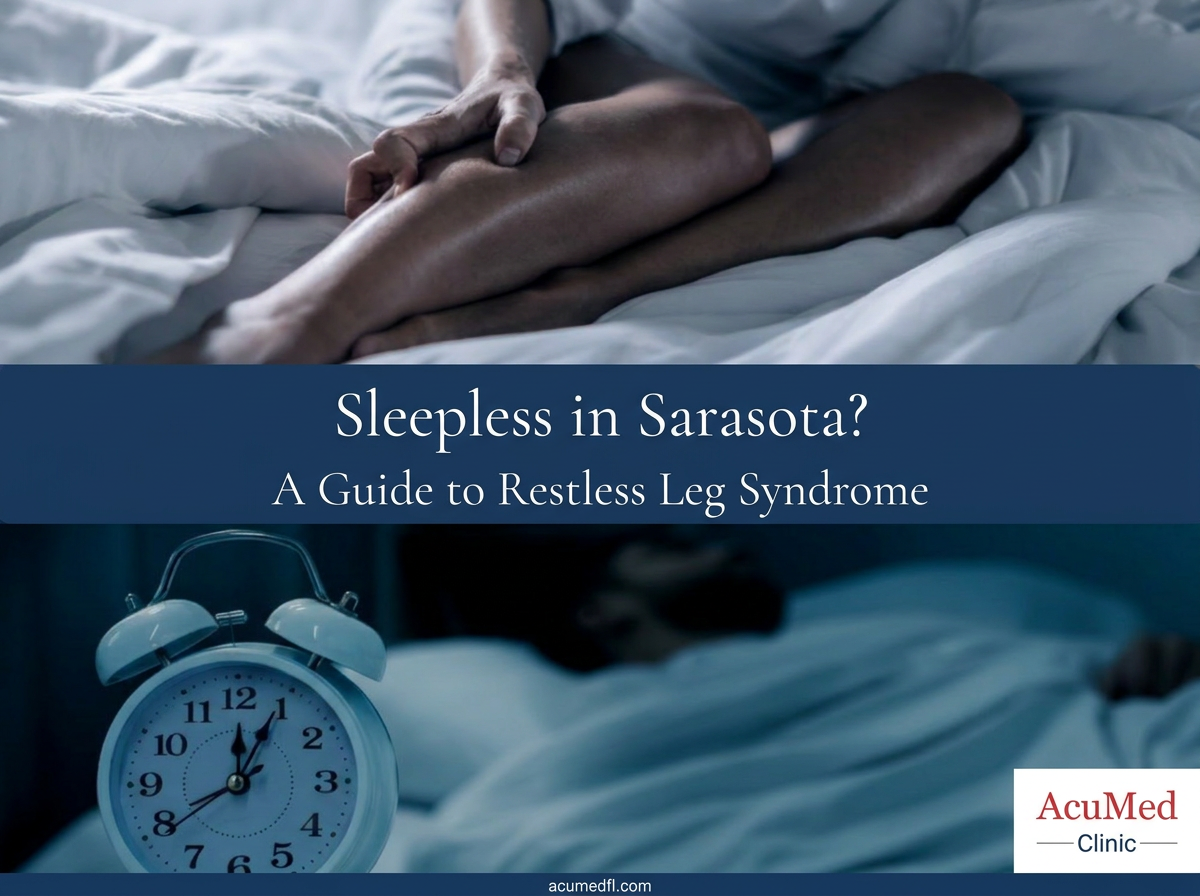
For many Sarasota residents, restless legs become most noticeable after long days on the golf course, extended drives across Florida, evenings spent at the theater, or flights back and forth from seasonal homes.
It starts the moment you finally lie down. Your legs feel restless — a crawling, tingling, almost electric urge to move them. You shift. You stretch. You kick the covers off. The sensation fades for a second, then it's back. By 2 a.m., you've paced the hallway twice, and you're no closer to sleep than when you got into bed.
If that sounds familiar, you are not alone. Restless leg syndrome in Sarasota is more common than most people realize, and it is one of the more misunderstood conditions I see in clinical practice as an Acupuncture Physician. Patients often come in having been told to "just deal with it" — or carrying a prescription that leaves them groggy, dependent, or no better than before.
What Is RLS and Why Does Conventional Treatment So Often Fall Short?
Restless leg syndrome (RLS) is a neurological sensory disorder characterized by an uncontrollable urge to move the legs, typically triggered by rest and worsened at night. It is not a minor nuisance. Chronic sleep disruption compounds over time, contributing to mood instability, cognitive decline, weakened immune function, and increased cardiovascular risk.
Conventional medicine typically reaches for dopamine agonists or anticonvulsants as first-line treatment. These medications can offer relief — but they come with trade-offs. Dopamine agonists carry a well-documented risk of augmentation, a paradoxical worsening of symptoms with long-term use. Many patients find their symptoms spreading to the arms, emerging earlier in the day, and becoming more intense. Others experience compulsive behavioral side effects. Anticonvulsants can cause sedation, dizziness, and dependency concerns.
This is not an argument against medication — it is a recognition that medication alone often leaves significant gaps, and that many patients are actively looking for drug-free RLS options that address root contributors rather than suppress symptoms.
What Is Actually Causing Your Restless Legs at Night?
Understanding the underlying drivers of RLS makes a meaningful difference in how you approach it.
Iron and dopamine. The strongest established connection in RLS research is between iron deficiency and dopamine dysregulation. Iron is essential to dopamine synthesis in the brain. When iron stores are low — even when standard blood counts look "normal" — dopamine signaling falters, and sensory symptoms in the legs follow. Checking serum ferritin (not just hemoglobin) is critical, because ferritin can be depleted before anemia appears.
Peripheral neuropathy. RLS and peripheral neuropathy frequently overlap, which is why a thorough evaluation matters. Neuropathy — nerve damage often associated with diabetes, autoimmune conditions, chemotherapy, or B12 deficiency — creates its own set of sensory symptoms that can be difficult to distinguish from primary RLS. In some patients, treating the underlying neuropathy significantly reduces leg symptoms.
Medications as a trigger. Several common medications can worsen or trigger RLS: antihistamines, certain antidepressants (particularly SSRIs and tricyclics), antipsychotics, and some anti-nausea drugs. If your symptoms emerged or worsened after starting a new medication, that timing is worth discussing with your prescribing provider.
Genetics and chronic conditions. RLS runs in families — a genetic predisposition is well established. It also appears at higher rates in people with kidney disease, pregnancy, rheumatoid arthritis, and Parkinson's disease. Women are diagnosed with RLS at roughly twice the rate of men.
What makes symptoms worse?
Caffeine and alcohol are common aggravators. Prolonged sitting — on a long flight, in a car, or at a desk — frequently brings symptoms on. Temperature also plays a role: many patients notice that cool environments help, while warmth intensifies the discomfort.
Sleep deprivation itself can become part of the cycle. The less sleep a person gets, the more sensitive the nervous system may become to discomfort and sensory disturbances.
Why Sleep Disorders and RLS Get Confused
Many people with restless leg syndrome initially assume they have a sleep problem rather than a neurological condition. After all, the most obvious symptom is often poor sleep.
The challenge is that RLS creates a cycle. The uncomfortable sensations in the legs make it difficult to fall asleep, leading to fatigue the next day. Over time, patients begin focusing on the exhaustion, brain fog, irritability, and low energy rather than the sensations that are causing them.
RLS can also overlap with other sleep disorders, including insomnia and sleep apnea. Some patients are treated for sleep problems for years before anyone asks about the urge to move their legs at night.
This distinction matters because treating sleep alone may not address the underlying driver of the problem. If restless leg syndrome is contributing to your symptoms, identifying and addressing the condition itself may be an important step toward better sleep and improved quality of life.
How Restless Leg Syndrome Affects Life in Sarasota
For many people, the most disruptive part of restless leg syndrome is not the sensation in the legs — it's what happens the next day.
A poor night's sleep has consequences. The fatigue accumulates. Concentration suffers. Mood becomes less resilient. Activities that once felt enjoyable begin to feel like work.
In Sarasota and Manatee County, where many people have chosen an active retirement lifestyle, that loss of energy can quietly erode quality of life. The morning walk on Siesta Key gets skipped because you're too tired. The afternoon round of golf becomes less enjoyable because you're running on four hours of fragmented sleep. The pickleball match you normally look forward to feels exhausting before it even starts.
Even simple pleasures can begin to disappear. Spending time with grandchildren, attending community events, working in the garden, swimming laps in the pool, or meeting friends for dinner all become harder when you're chronically sleep deprived.
Many patients tell me they initially thought they had an energy problem, not a sleep problem. It wasn't until they addressed the restless legs disrupting their sleep that they realized how much of their fatigue, brain fog, and reduced motivation were connected to what was happening every night.
Some patients develop their own routines to get through the night, including stretching, walking, massage, magnesium cream, or cooling the legs before bed.
Restless leg syndrome doesn't just affect your legs. It affects your recovery, your energy, your mood, and ultimately your ability to enjoy the Sarasota lifestyle you've worked hard to build.
What Drug-Free RLS Treatment Looks Like at AcuMed Clinic
AcuMed Clinic is designed around exactly this kind of complex, multi-layered condition. Restless legs at night often have more than one driver, and the care plan needs to reflect that.
Acupuncture is well-supported in the research for improving sleep quality, calming the nervous system, and addressing the sensory dysregulation that underlies RLS. Sarasota acupuncture patients at AcuMed Clinic often notice meaningful improvement in symptom intensity and frequency over a course of treatment. We also incorporate auricular therapy — ear acupuncture — which has specific protocols for sleep and neurological regulation. Chinese herbal medicine and bio-electric medicine round out the toolkit, targeting circulatory function, nerve signaling, and the inflammation pathways that can amplify leg discomfort.
We accept BCBS and UHC and work with VA Community Care. We are also enrolling with Medicare and will be one of the few Medicare-credentialed acupuncture providers in Southwest Florida. For patients whose condition is appropriate for a shared-room setting, community acupuncture — a 30-minute appointment with full intake and acupuncture treatment included — is also available.
Frequently Asked Questions About RLS and Acupuncture
Does acupuncture actually help restless leg syndrome?
Research on acupuncture for RLS is growing, and clinical outcomes are encouraging. Many patients find that regular acupuncture reduces the frequency and intensity of nighttime symptoms, particularly when combined with lifestyle modifications. It is not a guaranteed cure, but it is a legitimate, low-risk option worth exploring — especially for those who have not found adequate relief with conventional approaches.
How do I know if I have RLS or just poor sleep?
The hallmark of RLS is the urge to move — a crawling, aching, or electric sensation that is triggered by rest and temporarily relieved by movement. It is consistently worse in the evening and at night. If your sleep difficulty is tied to leg discomfort that eases when you get up and walk, RLS is a reasonable diagnosis to explore with your provider.
Can iron deficiency cause restless legs?
Yes, and this connection is frequently overlooked. Ferritin levels below 50 to 75 ng/mL are associated with worsened RLS symptoms, even when red blood cell counts are technically normal. If you have not had a full iron panel including ferritin, it is worth requesting one.
Is RLS treatment covered by insurance?
Acupuncture for related conditions — including chronic pain and neurological symptoms — is covered by most BCBS and UHC and VA Community Care plans. Coverage specifics vary by plan. Medicare coverage for acupuncture is currently limited to chronic low back pain. We encourage patients to contact us so we can help clarify what their plan covers before their first visit.
What can I do at home to manage symptoms tonight?
Moderate exercise during the day — not too close to bedtime — can reduce symptom severity. Avoiding caffeine after noon and limiting alcohol is consistently helpful. Some patients find that cool leg compresses, magnesium supplementation, or topical magnesium cream applied to the legs before bed can reduce muscle tension and improve comfort. Maintaining a regular sleep schedule is also important. These are supportive strategies, not replacements for a proper evaluation and treatment plan, but they can be reasonable steps to try while seeking care.
Why are my restless legs worse at night?
Restless leg syndrome follows a circadian pattern, meaning symptoms naturally become more noticeable in the evening and at night. Symptoms are also triggered by rest, so when you finally sit down or lie down to sleep, the urge to move your legs often becomes much stronger. Many people find that the combination of reduced activity, changes in dopamine signaling, and fewer daytime distractions makes RLS most disruptive at bedtime.
Can neuropathy cause restless legs?
Yes. Peripheral neuropathy and restless leg syndrome frequently overlap, and some of the symptoms can feel very similar. Nerve damage associated with diabetes, chemotherapy, vitamin deficiencies, or other conditions may cause burning, tingling, crawling, or uncomfortable sensations in the legs that worsen at night. Because the two conditions can occur together, a thorough evaluation is important to determine whether neuropathy, RLS, or both may be contributing to your symptoms.
If restless leg syndrome has been disrupting your sleep in Sarasota, there are options beyond managing it night by night. Visit acumedfl.com to learn more about what AcuMed Clinic offers and to request an appointment.
Ready to Sleep Better in Sarasota?
AcuMed Clinic opens soon in Sarasota. Dr. Kitt treats restless leg syndrome with drug-free, non-surgical approaches including acupuncture, auricular therapy, and bio-electric medicine.
(941) 250-6911
We accept BCBS, UHC, VA Community Care, and are enrolling with Medicare. Community acupuncture — a 30-minute shared-room appointment with full intake and treatment included — is also available.