Joint pain and arthritis are not the same thing — and knowing the difference changes your care options. Learn how to tell them apart, what drives arthritis in active Sarasota and Manatee County adults, and how drug-free, non-surgical approaches can help you stay active.
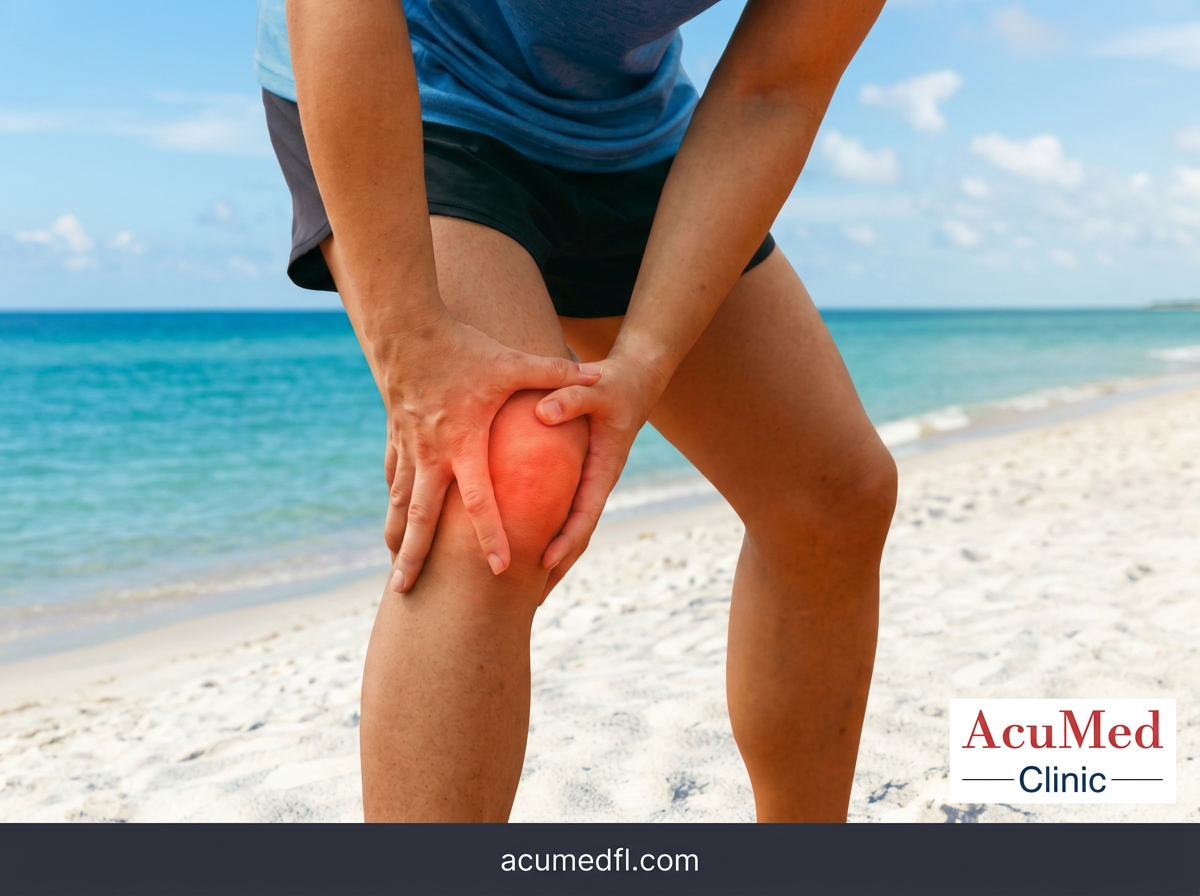
Talking to my fellow Sarasota and Manatee County residents: you're three holes into your round at one of the beautiful courses along the coast and your knee starts complaining. Or you're twenty minutes into pickleball and your shoulder decides it's done for the day. Or you wake up and your hip takes fifteen minutes to loosen up enough to walk normally — before you can even think about heading down to Siesta Key or Longboat Key for your morning walk. You chalk it up to "getting older" or "just arthritis" — but do you actually know which one you're dealing with?
Joint pain is one of the most common reasons adults over fifty pull back from the activities they love. It's also one of the most misunderstood, because "joint pain" and "arthritis" get used interchangeably when they're actually two different things. One is a symptom. The other is a diagnosis. Understanding which you have — and specifically what kind — matters enormously for choosing the right approach to care.
Joint Pain Is a Symptom, Not a Diagnosis
Joint pain is exactly what it sounds like: pain coming from a joint. It's a symptom, the way a headache is a symptom. It tells you something is wrong, but it doesn't tell you what. Joint pain can come from muscle strain, ligament damage, bursitis (inflammation of the fluid-filled sacs that cushion joints), tendinitis, gout, infection, or dozens of other sources — many of which have nothing to do with arthritis.
Arthritis, on the other hand, is a diagnosis — specifically, inflammation or degeneration of the joint itself. There are more than 100 types of arthritis, but in the patients I see most often in Sarasota and Manatee County, the vast majority fall into two main categories: osteoarthritis and rheumatoid arthritis. They look and behave very differently, they have different underlying causes, and they respond to different approaches.
Knowing which category you're in is the foundation of an effective care plan. "My joints hurt" is the starting point of the conversation, not the end of it.
Osteoarthritis: The Wear-and-Tear Version
Osteoarthritis — often abbreviated OA — is the most common form of arthritis, and the one most people are thinking of when they say "I have arthritis." It develops when the cartilage that cushions the ends of bones within a joint gradually breaks down. Cartilage is the slick, rubbery tissue that allows joint surfaces to glide smoothly against each other. When it wears thin or away, bone begins to contact bone. That produces pain, stiffness, and often a grinding or clicking sensation during movement.
Osteoarthritis develops slowly, usually over years or decades. It is more common in older adults, in people who have had joint injuries in the past (including sports injuries that may have seemed minor at the time), and in those who carry more body weight, which increases the load on weight-bearing joints like the knees and hips. But it is not simply "old age" — it reflects accumulated stress on a specific joint or set of joints.
The hallmark features of osteoarthritis:
- Pain that worsens with activity and typically improves with rest
- Morning stiffness that lasts less than 30 minutes — the joint loosens up as you move
- Specific joint involvement — often the knees, hips, hands, and lumbar spine
- Gradual onset — it's hard to point to a single moment it started
- No systemic symptoms — OA stays local; it doesn't make you feel sick, feverish, or fatigued
Most golfers, pickleball players, and walkers I see in the clinic who describe joint pain that has been building slowly over years are dealing with some degree of osteoarthritis. That's not a reason to stop playing — it's a reason to address the joint environment so you can keep playing.
Rheumatoid Arthritis: When Your Immune System Attacks
Rheumatoid arthritis — RA — is a fundamentally different disease. It is an autoimmune condition: the immune system mistakes the lining of the joints (called the synovium) for a foreign threat and attacks it. This produces severe inflammation that, over time, can damage the cartilage, the underlying bone, and the ligaments and tendons around the joint.
Unlike osteoarthritis, rheumatoid arthritis is a systemic disease — meaning it affects the whole body, not just individual joints. It can cause fatigue, low-grade fever, and a general sense of illness. It tends to affect both sides of the body symmetrically — if your right wrist is involved, the left one likely is too. And crucially, it often affects the smaller joints first: fingers, wrists, ankles.
The hallmark features of rheumatoid arthritis:
- Morning stiffness that lasts more than an hour — sometimes much longer
- Symmetrical joint involvement — both hands, both wrists, both feet
- Systemic symptoms — fatigue, low-grade fever, general unwellness
- Fluctuating course — distinct flares and periods of relative quiet
- Elevated inflammatory markers on blood tests (CRP, ESR, positive rheumatoid factor or anti-CCP antibodies)
RA requires management under a rheumatologist, and the treatments — including disease-modifying drugs (DMARDs) and biologics — are quite different from what addresses osteoarthritis. If you haven't been formally diagnosed and the features above sound familiar, that workup is important.
What Drug-Free, Non-Surgical Care Can Actually Do
For osteoarthritis specifically, and as a complement to medical management of RA, drug-free and non-surgical approaches can make a meaningful difference — not by reversing damage that has already occurred, but by addressing what keeps the joint environment inflamed, limiting how much the joint deteriorates going forward, and restoring function that pain and guarding have eroded.
Acupuncture has a well-documented record in osteoarthritis research, particularly for the knee. It works through several mechanisms simultaneously: reducing local inflammation in and around the joint, modulating pain signals in the nervous system, and improving blood flow to the joint tissue. Laser therapy adds the capacity to stimulate cellular repair processes in damaged tissue. BEMER — a form of bioelectromagnetic therapy — supports microcirculation, the tiny blood vessel flow that feeds cartilage and joint tissue. None of these approaches are a cure. But for someone who wants to keep playing pickleball or walking Siesta Key beach for another decade, slowing the progression and keeping function high is a meaningful goal.
The non-surgical framing matters especially for Sarasota and Manatee County's active retiree population, because joint replacement is often presented as the natural endpoint of severe osteoarthritis. For many people, it eventually becomes the right answer. But there is a long stretch of the road before that point where thoughtful, integrative care can preserve quality of life and extend the window of active, independent living.
What That Means for Your Care at AcuMed
At AcuMed Clinic, we approach joint pain and arthritis by first understanding which you're actually dealing with — and what's underneath the symptoms. That means a thorough intake: where it hurts, when, what makes it better or worse, what your imaging shows if you've had any, and what your goals are. A pickleball player who wants to compete has different priorities than someone who just wants to walk without pain, and the care plan reflects that.
We accept BCBS and UHC, VA Community Care, and are enrolling in Medicare. If joint pain or arthritis has been limiting your activity in Sarasota or Manatee County, we'd like to help you understand your options — including which ones don't involve surgery or long-term medication.
If sciatica is part of your pain picture (sometimes related to hip and lumbar joint issues), read more in our upcoming posts: Sciatica: What's Actually Happening in Your Body and Acupuncture for Sciatica.
Frequently Asked Questions
What are the most common causes of arthritis in Sarasota adults?
The causes most relevant to the patients I see in this area include:
- Aging — joint cartilage naturally becomes less resilient over decades of use. Osteoarthritis becomes increasingly common after fifty, and particularly after sixty-five.
- Prior joint injuries — a knee sprain in your thirties, a shoulder separation from decades of tennis or golf, an ankle fracture that healed but changed your gait — these increase the likelihood of arthritis in those specific joints years or decades later.
- Sports and activity wear — the same active lifestyle that makes Sarasota and Manatee County such desirable places to retire can accumulate repetitive stress on joints over time, especially in weight-bearing joints.
- Family history — there is a heritable component to osteoarthritis, particularly in the hands and knees.
- Body weight — increased load on weight-bearing joints (knees, hips, lumbar spine) accelerates cartilage wear. For every additional pound of body weight, the force on the knee during walking increases by approximately four pounds.
Can Florida weather affect arthritis symptoms?
This is one of the most common questions I hear from patients who have moved here from cooler or drier climates, and from longtime residents who've noticed their joints seem to have their own weather forecast.
From a modern clinical perspective, barometric pressure drops — which precede storms and front systems — are associated with increased joint pain and swelling in many patients with osteoarthritis and rheumatoid arthritis. The mechanism is not fully established, but one well-supported hypothesis is that lower external pressure allows inflamed joint tissues to expand slightly, increasing pressure within the joint space. Florida's pattern of rapid pressure changes, high humidity, and seasonal tropical storm activity creates conditions that many arthritis patients notice acutely.
Acupuncture and Herbal Medicine has described environmental dampness, heat, and wind as contributing to joint pain and stiffness for centuries. The traditional framework understands these environmental conditions as capable of lodging in the joints and impairing their movement — producing what practitioners have long called "damp-cold bi syndrome" or "damp-heat bi syndrome," depending on the presentation. While modern medicine and AHM use different frameworks and different language, both traditions have observed the same basic pattern: the body's joint health does not exist in isolation from its environment. If a patient tells me their knees reliably worsen before a storm, I don't dismiss that. Both frameworks offer tools for addressing it.
How do I know if I have osteoarthritis or just general joint pain without seeing a doctor?
You can't be certain without a clinical evaluation, but there are useful clues. If the pain has come on gradually, gets worse with activity and better with rest, and is localized to specific joints without making you feel generally unwell, osteoarthritis is a reasonable candidate. If the pain is severe, came on suddenly, involves redness and warmth around the joint, or is accompanied by fever or fatigue, that warrants prompt medical attention — it may be an acute flare of inflammatory arthritis, gout, or an infection.
Is arthritis inevitable as you get older?
Some degree of joint wear is a natural part of aging, but significant osteoarthritis — the kind that limits function — is not inevitable. Genetics play a role, but so does joint load, prior injury, activity choices, and how you manage inflammation over your lifetime. Many people in their seventies and eighties have minimal osteoarthritic symptoms.
Can I still exercise with arthritis?
Not only can you — in most cases you should. Appropriate movement is one of the most consistently supported non-pharmacological approaches for osteoarthritis. It maintains the muscle support around joints, reduces stiffness, and keeps cartilage nourished through the compression and release of normal activity. The key is appropriate: matched to your specific joints, your current capacity, and your symptoms. A one-size-fits-all exercise recommendation is rarely helpful.
I've been told I need a knee replacement. Is there anything that could delay or avoid that?
Possibly, depending on the severity of the degeneration and your functional goals. Joint replacement is appropriate when pain and loss of function are severe and conservative measures have failed. But "conservative measures have failed" often means a short course of anti-inflammatories and some physical therapy — not a sustained, integrated approach. Many patients who explore drug-free integrative care find more improvement than they expected, which extends their quality of life and in some cases delays surgery significantly.
Does rheumatoid arthritis respond to the same treatments as osteoarthritis?
Not primarily. RA requires disease-modifying treatment that only a rheumatologist can provide. That said, integrative approaches can play a supportive role alongside RA medical management — helping to manage inflammation, reduce pain levels, and maintain function during flares or remissions. We work in coordination with your rheumatologist, not in place of them.
What is the difference between osteoarthritis and rheumatoid arthritis?
A simple way to think about it is:
- Osteoarthritis = joint wear and degeneration
- Rheumatoid arthritis = immune system-driven inflammation
Why Sarasota's Active Lifestyle Makes Joint Health a Priority
Sarasota and Manatee County attract people who want to stay active — and that's exactly the population for whom joint health matters most. Golf, pickleball, kayaking, cycling, beach walking, gardening, keeping up with grandchildren — these are not passive pursuits. They are the reasons people move here and the activities that define quality of life in this community.
The challenge is that the same active history that makes this community healthy also creates a higher cumulative load on joints over decades. Many of the patients I see have been athletic for most of their lives — and the joints that carried them through decades of sport and activity are now asking for some attention. That's not a failure. That's physics.
The good news is that joint health is not a one-way door. Osteoarthritis can be slowed. Function can be restored. Many patients who had written off golf or their morning walk on Longboat Key find they are able to return to those activities — not after surgery, but after a period of targeted, integrated care that addresses the joint environment and the inflammation driving their symptoms.
The framing that matters here is not "how bad is it" but "how much function do you want to preserve, and what are you willing to do about it now." The earlier that question gets asked — and answered — the more options remain on the table.
Stay Active in Sarasota and Manatee County — Start With a Conversation
Whether you've been diagnosed with arthritis or you're trying to understand why your joints have been holding you back, AcuMed Clinic offers drug-free, non-surgical care designed for people who want to stay active and independent. We see patients across Sarasota and Manatee County and would be glad to talk through what's going on and what might help.
Book your appointment at AcuMed Clinic — or visit acumedfl.com to learn more about what we offer.
Ready to Stay Active in Sarasota?
AcuMed Clinic opens soon in Sarasota. Dr. Kitt treats osteoarthritis and joint pain with drug-free, non-surgical approaches designed for active adults who want to keep doing what they love.
(941) 250-6911
We accept BCBS, UHC, VA Community Care, and are enrolling with Medicare. Community acupuncture — a 30-minute shared-room appointment with full intake and treatment included — is also available.