Struggling with chronic lower back pain in Sarasota? Learn why back pain keeps returning and explore drug-free, non-surgical treatment options at AcuMed Clinic.
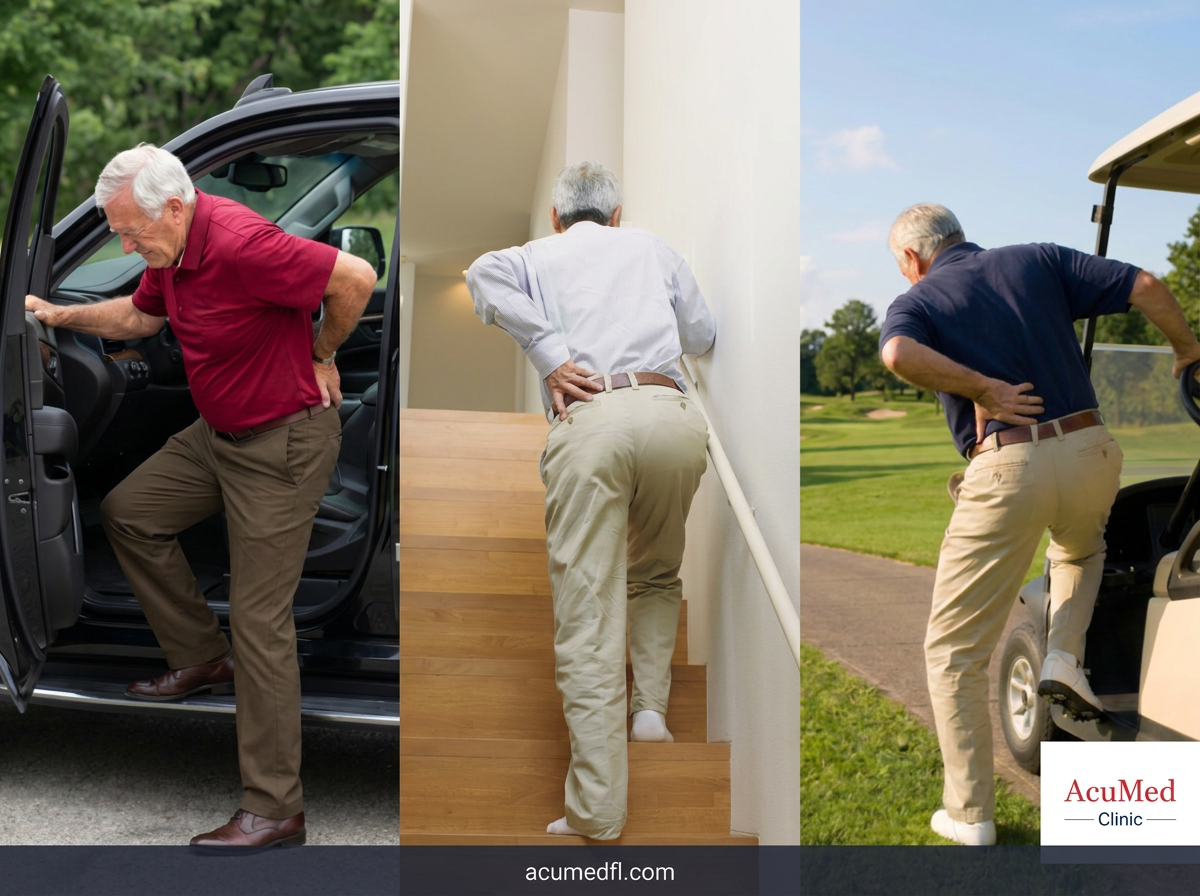
Talking to my fellow Sarasota and Manatee County residents: You know the feeling. You wake up thinking today might be the day it finally eases up. You move carefully — slowly out of bed, skipping the stretch that usually sets it off — and for a few minutes you think maybe you've turned a corner. Then you reach for your coffee and your lower back reminds you that no, it is absolutely still there.
As an Acupuncture Physician, I see this pattern every day. Sarasota acupuncture offers a drug-free path that addresses not just the pain itself but the nervous system patterns that keep it cycling.
Chronic lower back pain is one of the most common reasons adults in Sarasota seek care. Whether it's limiting your golf game, your pickleball matches, long walks on Siesta Key or Longboat Key, or simply getting through the day comfortably, persistent back pain can gradually take over your life.
Chronic lower back pain has a particular cruelty to it. Unlike a broken bone or a surgical wound, it doesn't follow a tidy arc toward healing. It flares, fades, flares again. It wraps itself around every ordinary thing — loading the dishwasher, sitting through a long drive, sleeping in the wrong position. If you've been living with it for months or years, you may have started to wonder whether your back is simply broken in some permanent way. It isn't. But understanding what is actually happening is the first step toward doing something useful about it.
What Makes Lower Back Pain "Chronic"
The term "chronic" has a clinical definition: pain that persists for twelve weeks or longer. Chronic lower back pain — sometimes called cLBP — is one of the most common conditions affecting adults in the United States, and it is especially prevalent among people over fifty. It is also one of the most misunderstood, partly because the word "chronic" tends to make people assume the condition is fixed or inevitable. It is neither.
What separates chronic lower back pain from an ordinary strain or pulled muscle is what is happening beneath the surface over time. An acute injury — say, tweaking your back moving furniture — produces a normal inflammatory response. Inflammation is your body's way of rushing repair resources to a damaged area. Under normal circumstances, inflammation does its job and resolves within a few weeks.
In chronic lower back pain, that resolution doesn't happen cleanly. The pain signals keep firing even after the original tissue injury has healed, or the source of the pain becomes entangled with structural changes, nerve sensitization, or patterns of muscle guarding that have built up over months and years. The nervous system, in a real and measurable way, can become "tuned" to pain — more sensitive, quicker to alarm, harder to quiet down. This is sometimes called central sensitization, and it helps explain why chronic lower back pain often feels like it has taken on a life of its own.
Why It Keeps Coming Back
One of the most frustrating aspects of chronic lower back pain is its tendency to cycle — to improve enough that you start doing normal things again, then spike hard the moment you do. Many patients describe feeling like they are always one bad morning away from being flattened again.
There are several reasons for this pattern.
First, the underlying drivers of the pain are often still present. Structural issues like disc degeneration (the slow wearing down of the cushioning discs between vertebrae), facet joint arthritis (inflammation and deterioration in the small joints that link each vertebra), or spinal stenosis (narrowing of the canal that houses the spinal cord) don't resolve on their own and can continue to generate pain signals even when you're otherwise feeling better.
Second, the muscles that surround and support the lower spine often develop abnormal tension and recruitment patterns in response to ongoing pain. When your back hurts, your body compensates — subtly shifting how you walk, how you sit, which muscles you recruit when you lift. Over time, those compensations become their own problem, loading the spine unevenly and keeping the surrounding tissues in a state of chronic low-grade irritation.
Third, there is often a significant contribution from the nervous system itself. Pain that has been present for a long time can change how the brain and spinal cord process sensation. This is not psychological weakness — it is measurable neuroscience. A nervous system that has spent months anticipating pain becomes very good at producing it.
What Conventional Approaches Often Miss
If you've been through the standard path — imaging, anti-inflammatories, maybe a round of physical therapy or a steroid injection — and you're still reading this, you already know the limitations. That isn't an indictment of conventional care. Imaging can identify structural changes, and short-term interventions can take the edge off acute flares. But they don't always address the full picture.
Medications manage the experience of pain; they don't recalibrate the nervous system or restore normal tissue function. Injections reduce localized inflammation but wear off, and repeated use carries its own risks. Standard physical therapy, done in isolation, may strengthen muscles without addressing the neurological dimension or the underlying tissue environment that keeps the pain cycling.
Drug-free, non-surgical approaches that engage the nervous system directly — not just the structure — tend to produce more durable results for many people with chronic lower back pain. That is where integrative care has a meaningful role to play.
At AcuMed Clinic, we focus on drug-free, non-surgical approaches to chronic pain management. Rather than simply suppressing symptoms, our goal is to improve function, calm pain pathways, and help patients return to the activities that matter most.
What That Means for Your Care at AcuMed
When a patient comes to AcuMed Clinic with chronic lower back pain, we don't treat a scan or a diagnosis. We treat a person — with a specific history, specific movement patterns, specific nervous system responses, and specific goals.
The approaches we use, including acupuncture, laser therapy, and auricular (ear) therapy, work through multiple pathways simultaneously: reducing local tissue inflammation, modulating pain signals in the nervous system, and supporting the body's own capacity to regulate and repair. Many patients with chronic lower back pain find that this kind of multi-system approach produces improvement where single-track interventions have plateaued.
We accept BCBS and UHC, VA Community Care, and will be one of the few Medicare-credentialed acupuncture providers in Southwest Florida — we are also able to serve Medicare patients with chronic low back pain under covered benefits. Coverage questions are always welcome, and we will help you understand your options before your first visit.
For more on what the research shows about acupuncture specifically for cLBP, see our upcoming post: Acupuncture for Chronic Low Back Pain.
Chronic lower back pain is one of the most common reasons patients seek care at AcuMed Clinic in Sarasota, particularly among active adults, retirees, golfers, pickleball players, and people who spend long hours sitting or driving.
Frequently Asked Questions
Does chronic lower back pain ever actually go away, or do I just have to manage it forever?
Many people with chronic lower back pain experience significant, sustained improvement — not just temporary relief. How much improvement is possible depends on the underlying drivers, how long the pain has been present, and what approaches are used. "Manage it forever" is not the only option, but it does require addressing the full picture, not just the symptomatic layer.
How is chronic lower back pain different from a herniated disc or sciatica?
A herniated disc (where the soft inner material of a spinal disc pushes out through the outer layer) can contribute to chronic lower back pain, and it can also cause sciatica — pain that travels down the leg along the sciatic nerve. These are related but distinct conditions. You can have chronic lower back pain without a herniated disc, and you can have a herniated disc without experiencing it as sciatica. We cover sciatica in a separate post in this series.
I've already had imaging — MRI, X-rays. Can't they just tell me what's wrong?
Imaging is useful, but it has well-documented limitations for chronic pain. Research consistently shows that many people with significant structural findings on MRI — disc bulges, degenerative changes — have no pain at all, while others with minimal structural findings experience severe, persistent pain. Imaging tells you about structure; it doesn't always explain pain. A thorough clinical evaluation considers imaging alongside your full history and how your body is actually moving and responding.
What's the difference between acute and chronic lower back pain in terms of how they're treated?
Acute pain — recent onset, usually tied to a clear event — responds well to rest, anti-inflammatory measures, and time. Chronic pain requires a different strategy because the mechanisms are different. The goal shifts from reducing acute inflammation to recalibrating the nervous system, restoring normal tissue function, and addressing the patterns that have developed over months or years.
Is it safe to exercise when my lower back is hurting?
In most cases, yes — with guidance. Prolonged bed rest is generally counterproductive for chronic lower back pain. Appropriate, progressive movement is one of the most evidence-supported approaches. The key word is appropriate: the right kind of movement for your specific situation, not a generic exercise video. A clinician who can evaluate your movement patterns will help you figure out what helps versus what aggravates.
What are the most common causes of chronic lower back pain in Sarasota adults?
- Arthritis
- Disc degeneration
- Muscle deconditioning
- Sedentary work
- Aging
- Repetitive strain
Can Florida weather make chronic back pain worse?
Many Sarasota/Manatee-area patients notice that their back pain seems to worsen before storms, during periods of high humidity, or when Florida's weather changes rapidly. While the exact mechanisms are still being studied, changes in barometric pressure, humidity, activity levels, and tissue sensitivity may contribute to symptom flares in some individuals.
Acupuncture and Herbal Medicine has described a similar phenomenon for centuries. In AHM, environmental influences such as dampness are believed to contribute to pain, stiffness, and a feeling of heaviness in the body. While modern medicine and AHM use different frameworks to explain these experiences, both recognize that environmental conditions can affect how pain is experienced.
Why Does My Back Hurt More Before It Rains?
The barometric change that precedes rain creates challenges for people living with chronic pain. High humidity, rapid weather changes, tropical storm systems, and seasonal pressure shifts are commonly reported triggers for back and joint pain. While these changes do not cause structural damage, they may influence how sensitive tissues and the nervous system respond to existing pain conditions.
Traditional Chinese Medicine describes many of these patterns in terms of dampness and other environmental influences that affect the body's normal balance and movement.
Ready to Take a Closer Look?
If chronic lower back pain has been limiting your life in Sarasota, we'd like to help you understand what's actually driving it — and what a realistic path forward might look like. The first step is a conversation.
Book a consultation at AcuMed Clinic — or visit us at acumedfl.com to learn more about how we approach chronic pain care.
Ready to Address Your Chronic Back Pain?
AcuMed Clinic opens soon in Sarasota. Dr. Kitt treats chronic lower back pain with drug-free, non-surgical approaches — and is enrolling with Medicare for qualifying cLBP patients.
(941) 250-6911
We accept BCBS, UHC, VA Community Care, and are enrolling with Medicare. Community acupuncture — a 30-minute shared-room appointment with full intake and treatment included — is also available.