Walnuts and pecans for joints, memory and aging in Chinese food therapy, plus 4 Thanksgiving recipes from a Sarasota acupuncture physician.
*By Dr. Katrina "Kitt" Chojnicki-Hill, DAOM, AP, Dipl. OM*
Whether you are lining up for a famous slice of homemade pecan pie at Yoder’s Restaurant, catching the warm, sweet aroma of cinnamon-roasted nuts drifting through the holiday events at University Town Center (UTC), or scooping up fresh nuts from the bulk bins at Detwiler’s Farm Market, walnuts and pecans are an unmistakable part of the season here in Sarasota.
Yet when Thanksgiving arrives, these nutrient-dense nuts usually get buried under corn syrup, refined brown sugar, and heavy pastry crusts.
In Asian Herbal Medicine (AHM) and Classical Food Therapy, however, Walnuts (Hu Tao Ren) and their close botanical cousin, pecans, are far more than a decadent pie filling. Rated a 5 out of 5 for nutritional value in our AHM Food Library, walnuts are one of the premier longevity foods in classical medicine—prized for warming the lower back and knees, sharpening memory, and soothing dry winter lungs.
Before you reach for a sugar-loaded slice of pie this Thanksgiving, let’s look at how these brain-shaped powerhouses actually work inside the body—and how different ways of preparing them can turn your holiday menu into genuine medicine.
The Energetics of Walnuts (Hu Tao Ren) & Pecans
In Classical Oriental Medicine, every food carries a thermal nature and targets specific organ systems:
- Thermal Nature: Warm
- Element / Season: Water (Winter)
- Organ Affinities: Kidney, Lung, and Large Intestine
- Primary Action: Tonifies Yang and Yin (specifically Kidney Yang and Jing/Essence)
- Damp-Forming: No
Notice the physical shape of a walnut or pecan half when you crack open the shell: it looks almost identical to the two hemispheres of the human brain. In classical medicine, this is no coincidence. Because the Kidneys govern the "sea of marrow"—which includes the brain, spinal cord, and bones—walnuts have been prescribed for centuries to support memory, cognitive clarity, and graceful aging.
At the same time, Kidney Yang serves as the pilot light that keeps your lower back, knees, and joints warm and flexible. As temperatures dip and holiday schedules pick up, incorporating warming Kidney tonics helps ease chronic low back stiffness and supports respiratory comfort.
Modern nutritional research strongly validates this ancient wisdom:
Brain & Joint Protection: Walnuts are the richest nut source of plant-based alpha-linolenic acid (ALA omega-3) and contain ellagitannins, which many people's gut bacteria convert into the potent anti-inflammatory compound urolithin A. Clinical research shows regular walnut consumption significantly lowers inflammatory biomarkers and improves joint pain scores.
Heart & Metabolic Support: Both walnuts and pecans are packed with monounsaturated fats, polyphenols, and antioxidants that support healthy cholesterol levels and cardiovascular resilience.
Gentle Moisture: Unlike sugary pastries that create sluggish "Dampness," walnuts provide clean, healthy oils that moisten dry winter lungs and lubricate the intestines to ease dryness-related constipation.
4 Ways to Prepare Walnuts & Pecans to Augment Your Health
You don't have to give up your favorite holiday flavors—and you can certainly still enjoy an occasional slice from Yoder’s! But for your everyday holiday table, how you prepare nuts determines whether they act as deep, restorative medicine or a blood-sugar spike. Try one of these four functional preparations:
1. Rosemary & Sea-Salt Spiced Nuts (For Joint Comfort & Circulation)
- Best for: Stiff lower backs, cold hands and feet, and pre-dinner holiday grazing.
- How to make it: Grab raw pecan and walnut halves from the bulk bins at Detwiler’s, toss with a teaspoon of olive oil, finely chopped fresh rosemary, sea salt, and a pinch of cayenne or cinnamon. Toast at 325°F for 10–12 minutes until fragrant.
- Why it works: Inspired by the warm roasted nuts you smell at UTC’s holiday festivities—minus the heavy refined sugar glaze—gentle roasting enhances the Warm thermal nature of the nuts while rosemary and cinnamon promote peripheral circulation and soothe aching joints.
2. Warm Walnut & Black Sesame Porridge (For Memory, Sleep & Longevity)
- Best for: Morning brain fog, winter fatigue, or restless sleep.
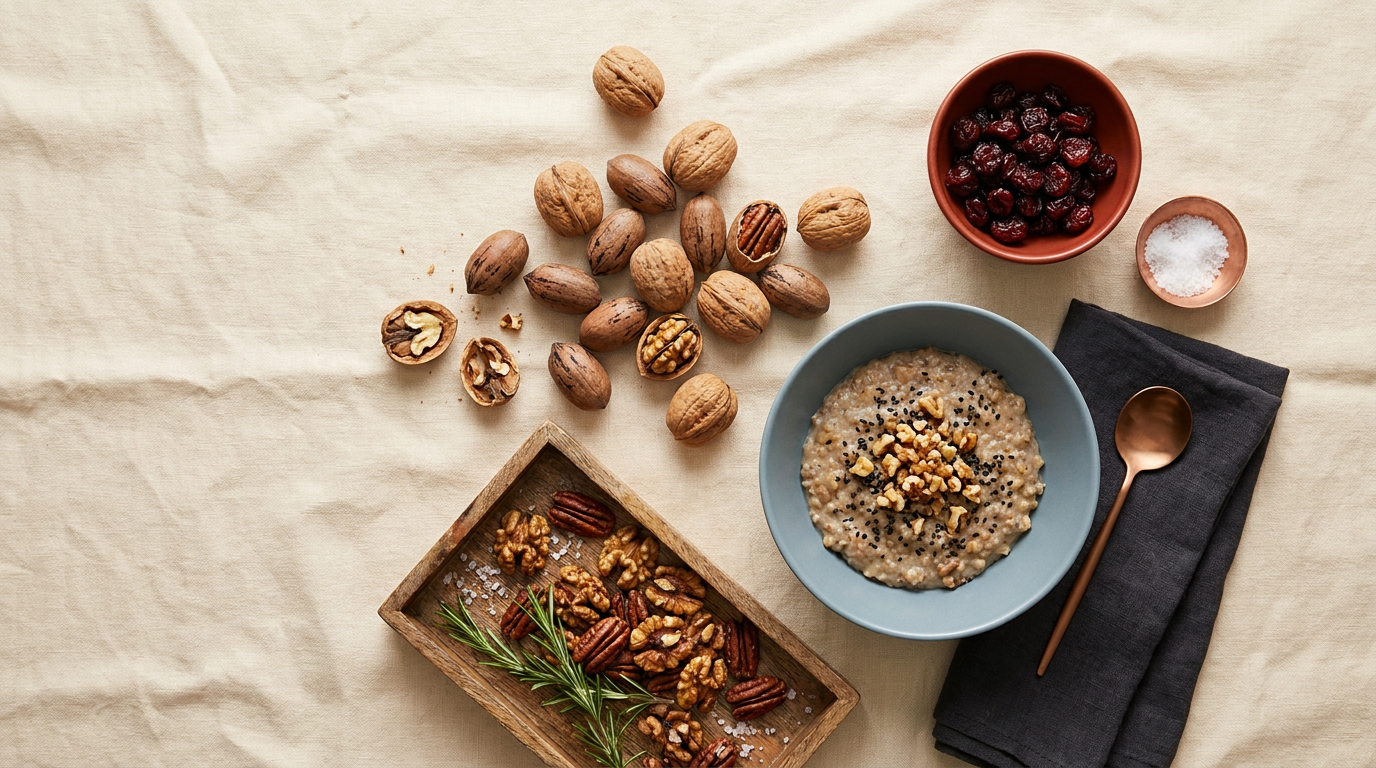
- How to make it: Simmer oats or rice congee until creamy, then stir in crushed toasted walnuts and ground black sesame seeds (easily found at HL Asian Market). Finish with a light drizzle of raw honey.
- Why it works: Pairing walnuts with black sesame seeds is one of the most famous longevity combinations in Classical Food Therapy—nourishing Kidney Essence, supporting memory, and helping calm the Spirit (Shen) for deeper, more restorative sleep.
3. Roasted Brussels Sprouts with Crushed Pecans & Balsamic (For Digestion & Heart Health)
- Best for: Balancing heavy Thanksgiving meats and preventing post-meal sluggishness.
- How to make it: Roast halved Brussels sprouts until crisp, then toss with toasted chopped pecans and a splash of aged balsamic vinegar.
- Why it works: The slight bitterness and fiber of Brussels sprouts stimulate liver and gallbladder flow to cut through rich holiday foods, while pecans add crunch, heart-healthy fats, and gentle intestinal lubrication.
4. Simple Raw Trail Mix with Dried Tart Cherries (For Suncoast Bike Rides)
- Best for: Steady energy during a morning bike ride along Lido Beach or cruising down The Legacy Trail.
- How to make it: Combine raw walnuts, pecans, pumpkin seeds (Nan Gua Zi), and unsweetened dried tart cherries.
- Why it works: Raw nuts preserve their delicate omega-3 fatty acids at peak potency, delivering sustained energy and anti-inflammatory joint support without the afternoon sugar crash.
A Quick Clinical Note on Balance
Because walnuts and pecans are rich, warming, and moistening, moderation is still important. If you are currently dealing with a phlegm-heat cough, active diarrhea, or loose stools, hold off on heavy nut intake until your digestion settles. For everyone else, a small handful (about 1 ounce) a day is plenty to reap the benefits.
If you have a tree nut allergy, avoid walnuts and pecans.
Explore More in Our AHM Food Library
Curious about how other everyday foods support your joints, digestion, and energy? Visit our interactive AHM Food Library at acumedfl.com/ahm-food-library/walnut to explore the thermal properties, organ affinities, and therapeutic benefits of dozens of foods.
If chronic low back pain, joint stiffness, or holiday stress is keeping you off your bike or the beach walk this season, Dr. Kitt and the team at AcuMed Clinic are here to help. Call (941) 250-6911 or visit acumedfl.com to schedule your consultation.
Sources
- Walnut ALA content: USDA FoodData Central, "Nuts, walnuts, english."
- Omega-3 (ALA) in foods: NIH Office of Dietary Supplements, Omega-3 Fatty Acids Fact Sheet for Health Professionals.
- Walnuts and inflammatory biomarkers: Cofán M, Rajaram S, Sala-Vila A, et al. Effects of 2-Year Walnut-Supplemented Diet on Inflammatory Biomarkers. J Am Coll Cardiol. 2020;76(19):2282-2284. doi:10.1016/j.jacc.2020.07.071
- Ellagitannins and urolithin A: Tomás-Barberán FA, García-Villalba R, González-Sarrías A, Selma MV, Espín JC. Ellagic acid metabolism by human gut microbiota: consistent observation of three urolithin phenotypes in intervention trials, independent of food source, age, and health status. J Agric Food Chem. 2014;62:6535-6538. doi:10.1021/jf5024615
- Urolithin metabotypes: Cortés-Martín A, García-Villalba R, González-Sarrías A, et al. The gut microbiota urolithin metabotypes revisited: the human metabolism of ellagic acid is mainly determined by aging. Food Funct. 2018;9(8):4100-4106. doi:10.1039/c8fo00956b
- Nuts and heart disease: U.S. Food and Drug Administration, Qualified Health Claims (nuts, 2003; walnuts, 2004).
- Pecans and cholesterol: Morgan WA, Clayshulte BJ. Pecans lower low-density lipoprotein cholesterol in people with normal lipid levels. J Am Diet Assoc. 2000;100(3):312-318.
- Hu Tao Ren (Semen Juglandis): Bensky D, Clavey S, Stöger E. Chinese Herbal Medicine: Materia Medica, 3rd ed. Eastland Press; 2004.
Related reading: More Than Just Your Pumpkin Spice Latte: How Thanksgiving Pumpkin Fuels Digestion, Calms the Spirit, and Supports Your Health
This article is for educational purposes only and is not medical advice.